Content ownership determines GST treatment of printed publications: customer-supplied text is a taxable printing service, owned content is exempt good...
Employee recoveries, input tax credit and notice pay recovery under GST: AAR distinguishes taxable supplies from non-taxable perquisites and penalties...
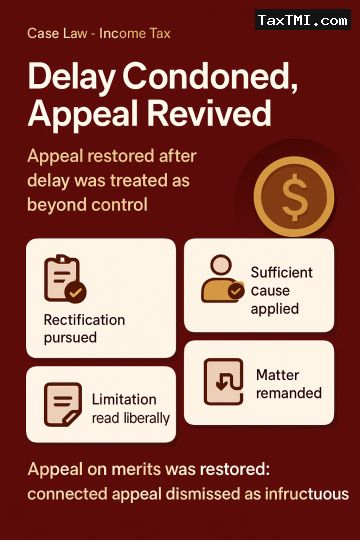
Delay in filing the appeal against the intimation under section 143(1) was condoned because the assessee had pursued rectification and a reminder, and the time taken in that process was treated as beyond its control. Applying the principle of sufficient cause, the Tribunal held that limitation provisions should be construed liberally to advance substantial justice where there is no negligence, inaction or lack of bona fides. The order dismissing the appeal on limitation was set aside and the matter was restored for decision on merits. The connected appeal against the rectification order was dismissed as infructuous after restoration of the main appeal.
Delay in filing the appeal against the intimation under section 143(1) was condoned because the assessee had pursued rectification and a reminder, and the time taken in that process was treated as beyond its control. Applying the principle of sufficient cause, the Tribunal held that limitation provisions should be construed liberally to advance substantial justice where there is no negligence, inaction or lack of bona fides. The order dismissing the appeal on limitation was set aside and the matter was restored for decision on merits. The connected appeal against the rectification order was dismissed as infructuous after restoration of the main appeal.
Note: It is a system-generated summary and is for quick reference only.
 TaxTMI
  TaxTMI
 of 4817


 Join Channel