Admissibility of electronic evidence bars undervaluation demands where printouts, retracted statements and no cross-examination leave the case unprove...
Limitation in oppression and mismanagement proceedings: prior knowledge of removal and dilution barred the challenge, with valuation directions upheld...
Insolvency professional agency governance rules amended to add nominee directors, tighten independent director eligibility, and regulate managing dire...
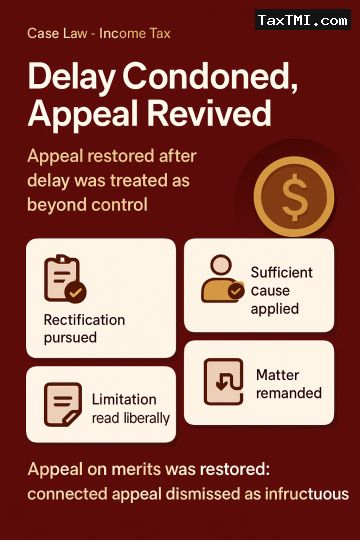
Delay in filing the appeal against the intimation under section 143(1) was condoned because the assessee had pursued rectification and a reminder, and the time taken in that process was treated as beyond its control. Applying the principle of sufficient cause, the Tribunal held that limitation provisions should be construed liberally to advance substantial justice where there is no negligence, inaction or lack of bona fides. The order dismissing the appeal on limitation was set aside and the matter was restored for decision on merits. The connected appeal against the rectification order was dismissed as infructuous after restoration of the main appeal.
Delay in filing the appeal against the intimation under section 143(1) was condoned because the assessee had pursued rectification and a reminder, and the time taken in that process was treated as beyond its control. Applying the principle of sufficient cause, the Tribunal held that limitation provisions should be construed liberally to advance substantial justice where there is no negligence, inaction or lack of bona fides. The order dismissing the appeal on limitation was set aside and the matter was restored for decision on merits. The connected appeal against the rectification order was dismissed as infructuous after restoration of the main appeal.
Note: It is a system-generated summary and is for quick reference only.
 TaxTMI
 of 4805


 Join Channel


 TaxTMI
