Prolonged sterilisation of development rights supports capital-gains treatment, while business-income disallowances cannot govern capital-gains comput...
Additional evidence in transfer pricing dispute leads to fresh examination, while tax deductions, TDS credit, fee and refund interest require verifica...
Category II AIF pass-through taxation preserves non-business income character; investment receipts cannot be reclassified without applying recognised ...
Mutual fund maturity rules require proper rollover, redemption, disclosure, and due diligence; investor gains cannot excuse regulatory breaches or pen...
Threshold exemption excludes exempt services, while stamp-paper purchases avoid reverse charge; consequential service tax penalties were also set asid...
Employee conflict disclosures and investment restrictions expand with new recusal duties, post-employment limits, and compliance reporting requirement...
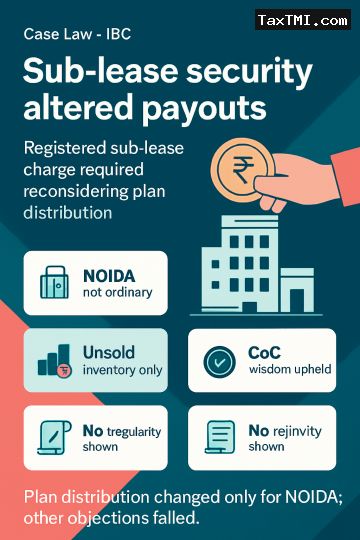
A registered sub-lease deed creating a first charge can constitute a security interest under the Insolvency Code, so NOIDA was not to be treated as an ordinary operational creditor and the resolution plan's distribution had to be reconsidered to that extent. By contrast, the lender's assignee could claim no higher security than the assignor, and its security over a real estate project was confined to unsold inventory because allotments to homebuyers were protected under RERA; the plan payment to the dissenting secured creditor therefore did not breach Sections 30(2)(b) or 53. Objections on valuation and plan comparison fell within the CoC's commercial wisdom, and no material irregularity was shown.
A registered sub-lease deed creating a first charge can constitute a security interest under the Insolvency Code, so NOIDA was not to be treated as an ordinary operational creditor and the resolution plan's distribution had to be reconsidered to that extent. By contrast, the lender's assignee could claim no higher security than the assignor, and its security over a real estate project was confined to unsold inventory because allotments to homebuyers were protected under RERA; the plan payment to the dissenting secured creditor therefore did not breach Sections 30(2)(b) or 53. Objections on valuation and plan comparison fell within the CoC's commercial wisdom, and no material irregularity was shown.
Note: It is a system-generated summary and is for quick reference only.
 TaxTMI
 of 4788






















 Join Channel


 TaxTMI
