Tax exemption for specified legal-services authority income applies retrospectively, subject to non-commercial activity, unchanged income sources, and...
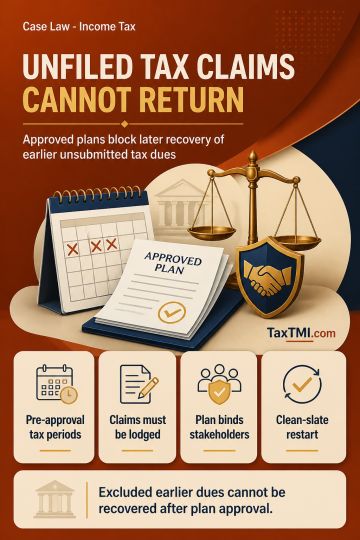
Approved resolution plans extinguish unsubmitted pre-approval tax claims, preventing later recovery outside the insolvency process and preserving a cl...
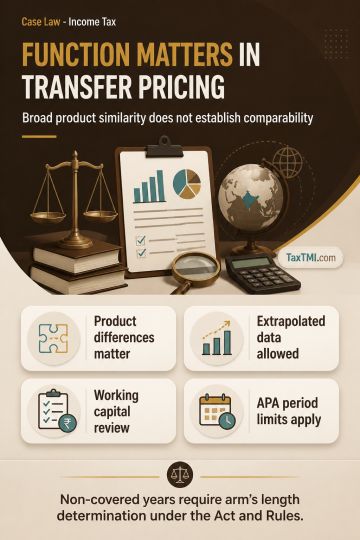
Transfer pricing comparability requires functional alignment and permits working capital adjustment, while APA margins cannot govern non-covered years...
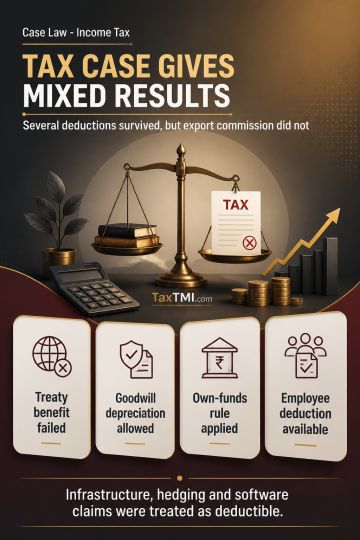
Treaty benefit, goodwill depreciation and hedging costs: export commission disallowed, while key business deductions and depreciation claims succeeded...
Page of 4790
Press 'Enter' after typing page number.
681 to 700 of 95794 Results
❮
❯
❯❯
0 / 200
Expand Note
Add to Folder
No Folders have been created
+
Are you sure you want to delete "My most important" ?
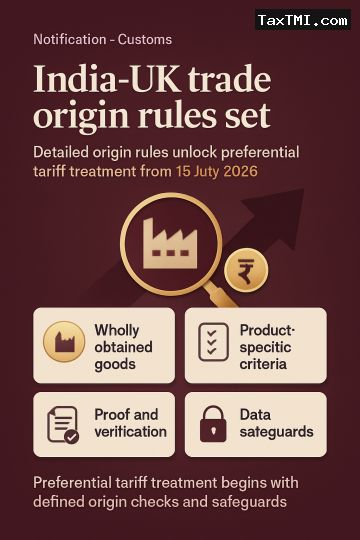
The Customs Tariff (Determination of Origin of Goods under the India-UK Comprehensive Economic and Trade Agreement) Rules, 2026 establish the origin framework for preferential tariff treatment from 15 July 2026. They define originating goods through wholly obtained status, production from originating materials, or compliance with product-specific rules in Annexure-A, and set methods for valuation, qualifying value content, cumulation, tolerance, non-alteration, proof of origin, verification, record-keeping, penalties and temporary suspension. The rules also prescribe origin declarations, certificates of origin, retrospective completion, low-value exemptions for the UK, and detailed customs verification procedures. Annexures provide product-specific origin rules, declaration templates, authentication through electronic exchange, and data protection safeguards for personal information shared for origin authentication.
The Customs Tariff (Determination of Origin of Goods under the India-UK Comprehensive Economic and Trade Agreement) Rules, 2026 establish the origin framework for preferential tariff treatment from 15 July 2026. They define originating goods through wholly obtained status, production from originating materials, or compliance with product-specific rules in Annexure-A, and set methods for valuation, qualifying value content, cumulation, tolerance, non-alteration, proof of origin, verification, record-keeping, penalties and temporary suspension. The rules also prescribe origin declarations, certificates of origin, retrospective completion, low-value exemptions for the UK, and detailed customs verification procedures. Annexures provide product-specific origin rules, declaration templates, authentication through electronic exchange, and data protection safeguards for personal information shared for origin authentication.
Note: It is a system-generated summary and is for quick reference only.
 TaxTMI
 of 4790









 Join Channel


 TaxTMI