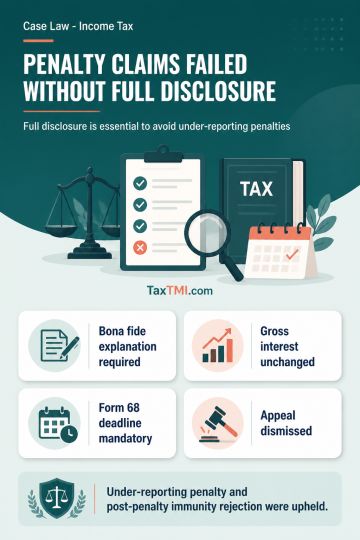
Bona fide disclosure requirements govern under-reporting penalties, and post-penalty immunity applications cannot secure available statutory protectio...
Certificate-of-origin verification procedure governs preferential customs benefits; denial without retroactive verification was set aside with consequ...
Disciplinary Committee jurisdiction and mandatory investigation requirements invalidated cancellation of an insolvency professional's registration and...
Retention of seized property survives where recorded reasons support proceeds of crime, while stayed investigation periods are excluded from limitatio...
Specified income of Baddi Barotiwala Nalagarh Development Authority receives conditional tax exemption, retrospectively covering its designated assess...
Page of 4788
Press 'Enter' after typing page number.
881 to 900 of 95752 Results
❮
❯
❯❯
0 / 200
Expand Note
Add to Folder
No Folders have been created
+
Are you sure you want to delete "My most important" ?
Advance Authorisation disputes over duty-free gold turned on whether later-regularised supporting manufacturers and clerical errors in export documents amounted to diversion or breach of the Actual User condition. The Tribunal treated dispatch to manufacturers later endorsed by DGFT as a curable procedural lapse, not unauthorised diversion, and found no basis for confiscation. It also accepted that excess jewellery over the invoice declaration arose from a clerical mistake, with no mens rea or pecuniary gain, so confiscation and redemption fine were unsustainable. Because the gold was seized before expiry of the export-obligation period and remained part of authorised imports, absolute confiscation was also set aside. Penalties failed with the confiscations and were deleted.
Advance Authorisation disputes over duty-free gold turned on whether later-regularised supporting manufacturers and clerical errors in export documents amounted to diversion or breach of the Actual User condition. The Tribunal treated dispatch to manufacturers later endorsed by DGFT as a curable procedural lapse, not unauthorised diversion, and found no basis for confiscation. It also accepted that excess jewellery over the invoice declaration arose from a clerical mistake, with no mens rea or pecuniary gain, so confiscation and redemption fine were unsustainable. Because the gold was seized before expiry of the export-obligation period and remained part of authorised imports, absolute confiscation was also set aside. Penalties failed with the confiscations and were deleted.
Note: It is a system-generated summary and is for quick reference only.
 TaxTMI
 of 4788




















 Join Channel



 TaxTMI