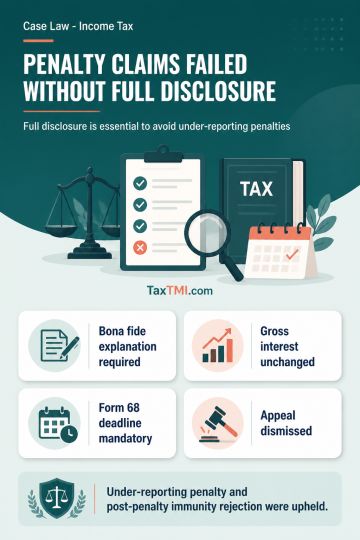
Bona fide disclosure requirements govern under-reporting penalties, and post-penalty immunity applications cannot secure available statutory protectio...
Certificate-of-origin verification procedure governs preferential customs benefits; denial without retroactive verification was set aside with consequ...
Disciplinary Committee jurisdiction and mandatory investigation requirements invalidated cancellation of an insolvency professional's registration and...
Retention of seized property survives where recorded reasons support proceeds of crime, while stayed investigation periods are excluded from limitatio...
Specified income of Baddi Barotiwala Nalagarh Development Authority receives conditional tax exemption, retrospectively covering its designated assess...
Page of 4788
Press 'Enter' after typing page number.
881 to 900 of 95752 Results
❮
❯
❯❯
0 / 200
Expand Note
Add to Folder
No Folders have been created
+
Are you sure you want to delete "My most important" ?
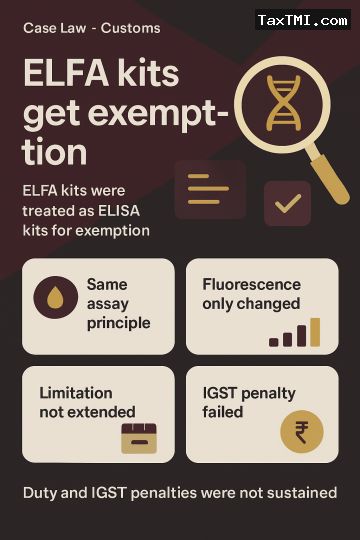
ELFA diagnostic kits were treated as covered by the ELISA exemption because the underlying enzyme-linked immunoassay principle remained the same and only the terminal detection method changed from colourimetric to fluorescence. The Tribunal held that strict construction of exemption entries cannot ignore scientific realities, and applied the genus-species principle and a purposive approach to conclude that technological advancement did not create a separate diagnostic class. It also held that the description of the goods as ELISA kits did not establish wilful suppression or intent to evade duty, so extended limitation was unsustainable. For the relevant period, IGST-related interest and penalty were also held not sustainable.
ELFA diagnostic kits were treated as covered by the ELISA exemption because the underlying enzyme-linked immunoassay principle remained the same and only the terminal detection method changed from colourimetric to fluorescence. The Tribunal held that strict construction of exemption entries cannot ignore scientific realities, and applied the genus-species principle and a purposive approach to conclude that technological advancement did not create a separate diagnostic class. It also held that the description of the goods as ELISA kits did not establish wilful suppression or intent to evade duty, so extended limitation was unsustainable. For the relevant period, IGST-related interest and penalty were also held not sustainable.
Note: It is a system-generated summary and is for quick reference only.
 TaxTMI
 of 4788




















 Join Channel


 TaxTMI