Business expenditure deduction requires proof of genuine commission payments and commercial allowability; turnover growth alone cannot validate the cl...
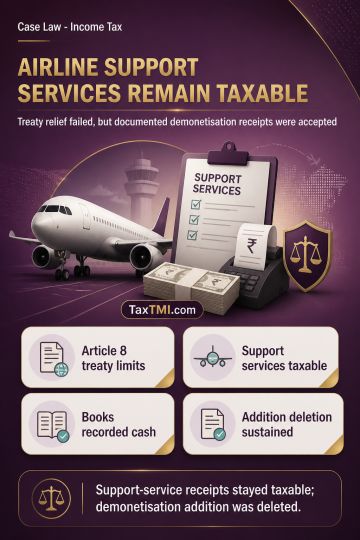
Article 8 treaty coverage excluded third-party airline support services, while documented demonetisation cash receipts remained accepted business inco...
Functional comparability under TNMM requires highway contract benchmarks to reflect operation, maintenance and transfer activities, requiring fresh be...
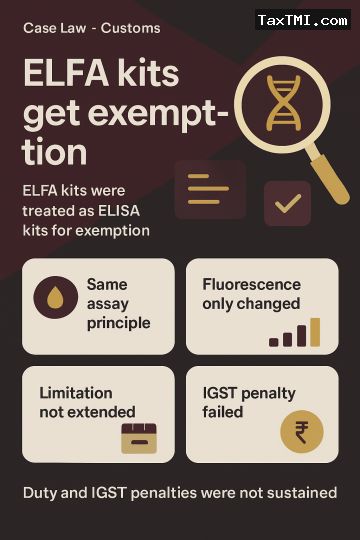
ELFA diagnostic kits were treated as covered by the ELISA exemption because the underlying enzyme-linked immunoassay principle remained the same and only the terminal detection method changed from colourimetric to fluorescence. The Tribunal held that strict construction of exemption entries cannot ignore scientific realities, and applied the genus-species principle and a purposive approach to conclude that technological advancement did not create a separate diagnostic class. It also held that the description of the goods as ELISA kits did not establish wilful suppression or intent to evade duty, so extended limitation was unsustainable. For the relevant period, IGST-related interest and penalty were also held not sustainable.
ELFA diagnostic kits were treated as covered by the ELISA exemption because the underlying enzyme-linked immunoassay principle remained the same and only the terminal detection method changed from colourimetric to fluorescence. The Tribunal held that strict construction of exemption entries cannot ignore scientific realities, and applied the genus-species principle and a purposive approach to conclude that technological advancement did not create a separate diagnostic class. It also held that the description of the goods as ELISA kits did not establish wilful suppression or intent to evade duty, so extended limitation was unsustainable. For the relevant period, IGST-related interest and penalty were also held not sustainable.
Note: It is a system-generated summary and is for quick reference only.
 TaxTMI
 of 4792














 Join Channel


 TaxTMI
