Capital reduction is distinct from share buy-back, preventing buy-back tax; restructuring interest and related business deductions also survive scruti...
Transfer pricing and tax deductions upheld on established principles, while employee contributions and warranty provisions returned for fresh examinat...
Captive transfer pricing relies on industrial consumer tariffs, while genuine quotations can benchmark effluent treatment transfers under the Other Me...
Specific tariff classification for ophthalmic instruments and extended limitation principles determine the treatment of duty demands, confiscation, an...
Integrated golf function determines classification, placing launch monitors and simulators under other golf equipment rather than measuring instrument...
Public servant status under anti-corruption law extends to recognised stock exchange leadership; constitutional and sanction challenges do not succeed...
Page of 4790
Press 'Enter' after typing page number.
961 to 980 of 95794 Results
❮
❯
❯❯
0 / 200
Expand Note
Add to Folder
No Folders have been created
+
Are you sure you want to delete "My most important" ?
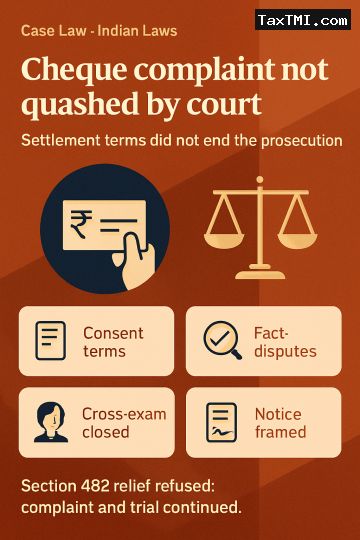
HC declined to quash a cheque dishonour complaint under the inherent jurisdiction because the consent terms prima facie suspended remedies without extinguishing the pending prosecution, and the dispute over transfer of liability and the effect of settlement raised factual and interpretive issues unsuitable for pre-trial interference. The Court distinguished settlements that subsume the original complaint and held that quashing is confined to cases where unimpeachable material completely displaces the allegations. It also upheld closure of cross-examination after repeated adjournments, rejected the challenge to framing of notice in light of counsel's submission that payment could not be made and the matter should proceed, and found no prejudice was shown in the recording of the accused's statement.
HC declined to quash a cheque dishonour complaint under the inherent jurisdiction because the consent terms prima facie suspended remedies without extinguishing the pending prosecution, and the dispute over transfer of liability and the effect of settlement raised factual and interpretive issues unsuitable for pre-trial interference. The Court distinguished settlements that subsume the original complaint and held that quashing is confined to cases where unimpeachable material completely displaces the allegations. It also upheld closure of cross-examination after repeated adjournments, rejected the challenge to framing of notice in light of counsel's submission that payment could not be made and the matter should proceed, and found no prejudice was shown in the recording of the accused's statement.
Note: It is a system-generated summary and is for quick reference only.
 TaxTMI
 of 4790




















 Join Channel


 TaxTMI