Capital reduction is distinct from share buy-back, preventing buy-back tax; restructuring interest and related business deductions also survive scruti...
Transfer pricing and tax deductions upheld on established principles, while employee contributions and warranty provisions returned for fresh examinat...
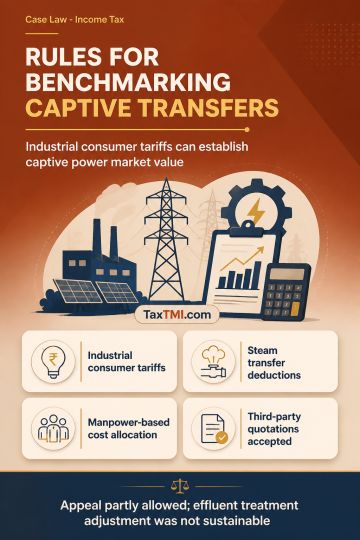
Captive transfer pricing relies on industrial consumer tariffs, while genuine quotations can benchmark effluent treatment transfers under the Other Me...
Specific tariff classification for ophthalmic instruments and extended limitation principles determine the treatment of duty demands, confiscation, an...
Integrated golf function determines classification, placing launch monitors and simulators under other golf equipment rather than measuring instrument...
Public servant status under anti-corruption law extends to recognised stock exchange leadership; constitutional and sanction challenges do not succeed...
Page of 4790
Press 'Enter' after typing page number.
961 to 980 of 95794 Results
❮
❯
❯❯
0 / 200
Expand Note
Add to Folder
No Folders have been created
+
Are you sure you want to delete "My most important" ?
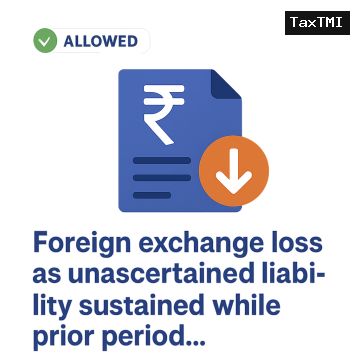
Insurance premium written back under extraordinary items required verification of whether the original disallowance of the larger amount had survived in appeal, and the balance addition was remitted for consequential recomputation after checking that status. Foreign exchange fluctuation loss was treated as a loss that crystallised only in the subsequent year when payment was made at a higher exchange rate, so it was regarded as an unascertained liability on the balance-sheet date and the disallowance, including the book profit add-back, was sustained. Prior period expenditure, including interest to financial institutions, was allowed in the year of payment where the liability had crystallised, and the corresponding disallowance was deleted.
Insurance premium written back under extraordinary items required verification of whether the original disallowance of the larger amount had survived in appeal, and the balance addition was remitted for consequential recomputation after checking that status. Foreign exchange fluctuation loss was treated as a loss that crystallised only in the subsequent year when payment was made at a higher exchange rate, so it was regarded as an unascertained liability on the balance-sheet date and the disallowance, including the book profit add-back, was sustained. Prior period expenditure, including interest to financial institutions, was allowed in the year of payment where the liability had crystallised, and the corresponding disallowance was deleted.
Note: It is a system-generated summary and is for quick reference only.
 TaxTMI
 of 4790















 Join Channel


 TaxTMI