Capital reduction is distinct from share buy-back, preventing buy-back tax; restructuring interest and related business deductions also survive scruti...
Transfer pricing and tax deductions upheld on established principles, while employee contributions and warranty provisions returned for fresh examinat...
Captive transfer pricing relies on industrial consumer tariffs, while genuine quotations can benchmark effluent treatment transfers under the Other Me...
Specific tariff classification for ophthalmic instruments and extended limitation principles determine the treatment of duty demands, confiscation, an...
Integrated golf function determines classification, placing launch monitors and simulators under other golf equipment rather than measuring instrument...
Public servant status under anti-corruption law extends to recognised stock exchange leadership; constitutional and sanction challenges do not succeed...
Page of 4790
Press 'Enter' after typing page number.
961 to 980 of 95794 Results
❮
❯
❯❯
0 / 200
Expand Note
Add to Folder
No Folders have been created
+
Are you sure you want to delete "My most important" ?
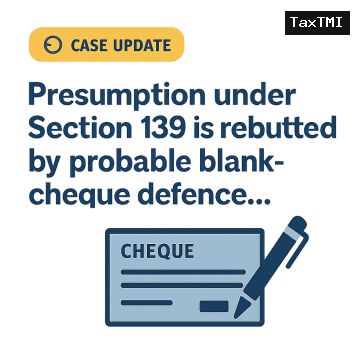
Absence of a money-lending licence does not by itself defeat a cheque-dishonour prosecution, but the complainant must still prove the foundational loan transaction once consideration is put in issue. On the facts discussed, the complainant could not give the particulars of the alleged loan, the date of disbursement, or the agreed interest, and produced no contemporaneous record of funds movement. The defence that signed blank cheques were issued in an existing professional and business relationship was treated as probable and sufficient to rebut the Section 139 presumption on a preponderance of probabilities. The trial court's view that no legally enforceable debt was proved was held to be a plausible one, so appellate interference with the acquittal was not warranted.
Absence of a money-lending licence does not by itself defeat a cheque-dishonour prosecution, but the complainant must still prove the foundational loan transaction once consideration is put in issue. On the facts discussed, the complainant could not give the particulars of the alleged loan, the date of disbursement, or the agreed interest, and produced no contemporaneous record of funds movement. The defence that signed blank cheques were issued in an existing professional and business relationship was treated as probable and sufficient to rebut the Section 139 presumption on a preponderance of probabilities. The trial court's view that no legally enforceable debt was proved was held to be a plausible one, so appellate interference with the acquittal was not warranted.
Note: It is a system-generated summary and is for quick reference only.
 TaxTMI
 of 4790

















 Join Channel


 TaxTMI