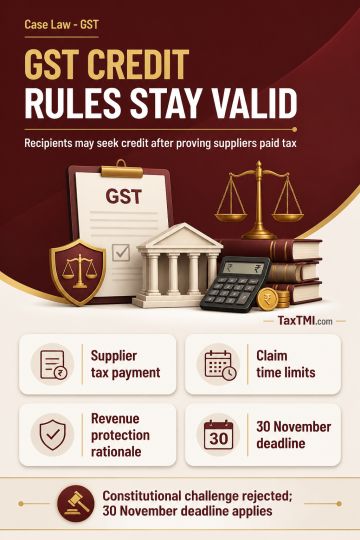
Input tax credit conditions remain constitutionally valid, with eligible recipient claims considered under GST circulars and retrospective filing dead...
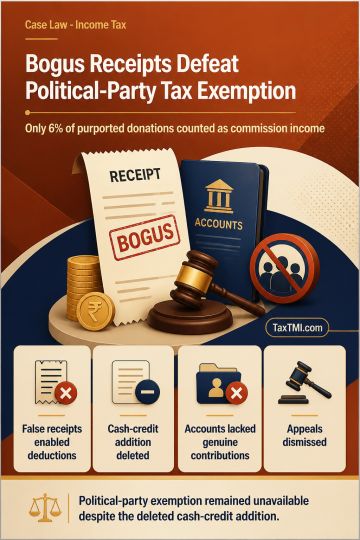
Bogus donation receipts justified commission income assessment and defeated political-party tax exemption for inaccurate accounts and reporting failur...
Pure reimbursement without income element escapes tax withholding, while delayed withholding and unsupported provisions face deferred or renewed scrut...
Public benefit requirement defeats charitable registration where residents' association services are reciprocal, member-only facilities governed by mu...
Exempt-income expenditure disallowance is confined to investments that actually generated exempt income, while supported business expenses remain dedu...
Page of 4796
Press 'Enter' after typing page number.
621 to 640 of 95918 Results
❮
❯
❯❯
0 / 200
Expand Note
Add to Folder
No Folders have been created
+
Are you sure you want to delete "My most important" ?
Article 226(2) is discussed as extending writ jurisdiction where the cause of action spans more than one State, so judicial remedies are not defeated by territorial limits. The text explains that insolvency proceedings in Bombay and the later alienation of secured assets in Bengaluru were treated as part of the same chain of cause of action, supporting consequential directions over the properties. It also states that Sub-Registrars are statutory functionaries whose duty to implement binding judicial directions is ministerial, not discretionary, and they cannot review or disregard such orders. The article notes that mandamus was issued to compel compliance, update registration records, and deal with the concerned representations.
Article 226(2) is discussed as extending writ jurisdiction where the cause of action spans more than one State, so judicial remedies are not defeated by territorial limits. The text explains that insolvency proceedings in Bombay and the later alienation of secured assets in Bengaluru were treated as part of the same chain of cause of action, supporting consequential directions over the properties. It also states that Sub-Registrars are statutory functionaries whose duty to implement binding judicial directions is ministerial, not discretionary, and they cannot review or disregard such orders. The article notes that mandamus was issued to compel compliance, update registration records, and deal with the concerned representations.
Note: It is a system-generated summary and is for quick reference only.
 TaxTMI
 of 4796












 Join Channel



 TaxTMI