Inherited property sale proceeds require capital-gains treatment where ownership is supported by evidence, not suspicion or unverified signature doubt...
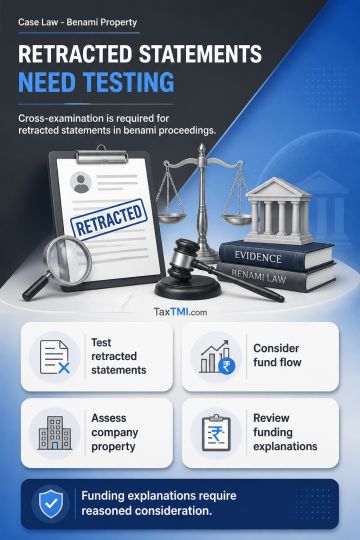
Cross-examination of retracted statements is essential where foundational evidence supports a benami allegation and documented funding explanations re...
Capital-goods exemption covers plant-modernisation accessories, while the import restriction applies only to earlier capital-goods components and spar...
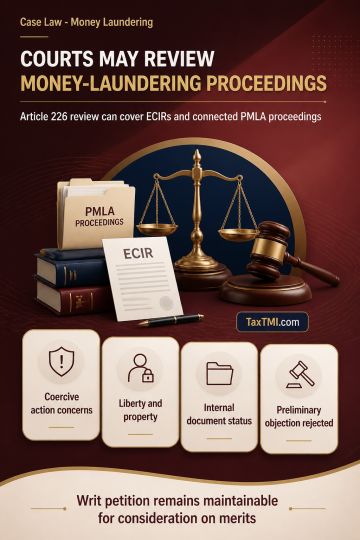
Constitutional judicial review permits challenges to ECIRs and connected money-laundering proceedings where coercive action affects fundamental intere...
Only the profit element embedded in on-money receipts was held taxable, because the Tribunal examined the assessee's disclosed receipts, profit and loss account, gross revenue and project cost, and found that taxing the entire on-money would create an unrealistically high net profit ratio for the real estate business. The Tribunal therefore treated the receipts as containing profit only and, on estimate, enhanced the addition from 20% to 40%. The High Court held this to be a factual appreciation and estimation exercise, not a substantial question of law. Both the Revenue's challenge for full addition and the assessee's challenge to the higher estimate were rejected.
Only the profit element embedded in on-money receipts was held taxable, because the Tribunal examined the assessee's disclosed receipts, profit and loss account, gross revenue and project cost, and found that taxing the entire on-money would create an unrealistically high net profit ratio for the real estate business. The Tribunal therefore treated the receipts as containing profit only and, on estimate, enhanced the addition from 20% to 40%. The High Court held this to be a factual appreciation and estimation exercise, not a substantial question of law. Both the Revenue's challenge for full addition and the assessee's challenge to the higher estimate were rejected.
Note: It is a system-generated summary and is for quick reference only.
 TaxTMI
 of 4794










 Join Channel


 TaxTMI