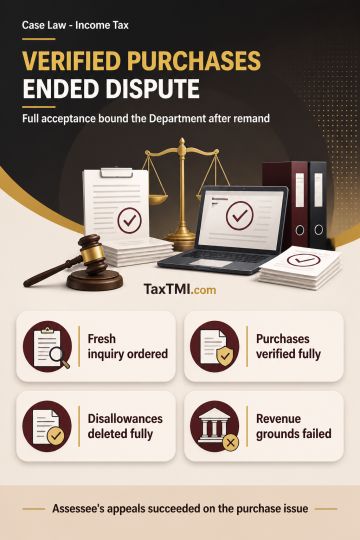
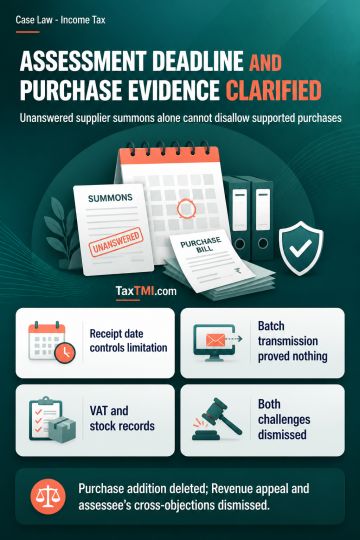
Limitation for consequential assessments runs from prescribed authority receipt, while verified purchases cannot be disallowed merely for unanswered s...
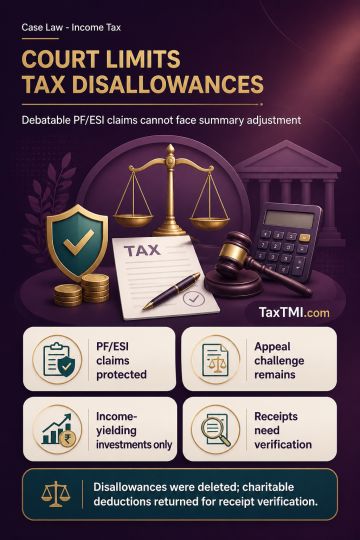
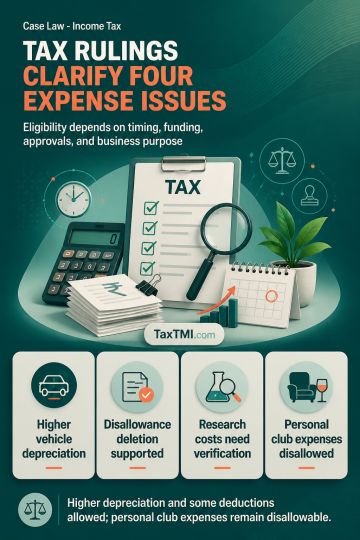
Higher depreciation for qualifying commercial vehicles, exempt-income disallowance, research deduction verification, and club-expense treatment clarif...
Charitable registration renewal cannot become an assessment of receipts, profitability or annual exemption compliance, requiring renewal and donation ...
AMP expenditure for own business is not an international transaction without an associated-enterprise arrangement, eliminating transfer pricing adjust...
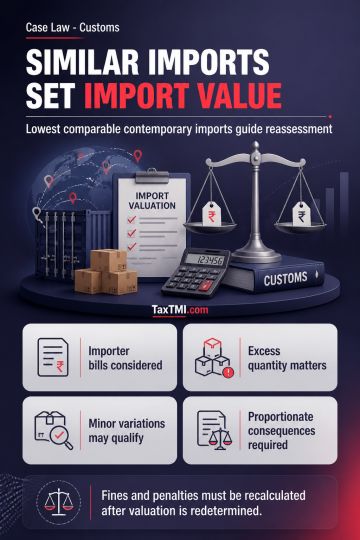
Customs valuation must use comparable contemporary imports, while confiscation fines and penalties require proportionate recalculation on reassessed v...
Page of 4805
Press 'Enter' after typing page number.
61 to 80 of 96092 Results
❮
❯
❯❯
0 / 200
Expand Note
Add to Folder
No Folders have been created
+
Are you sure you want to delete "My most important" ?
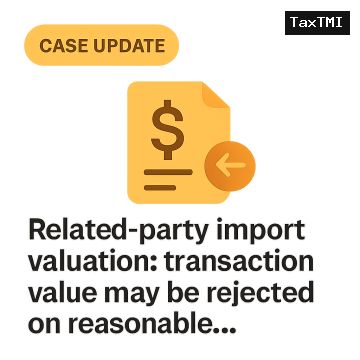
Related-party imports allow rejection of declared transaction value where common family control creates a reasonable doubt about the truth and accuracy of the price, and proof of additional cash payment is not required once that doubt arises. After rejection, customs valuation must follow the prescribed methods sequentially, and the authority cannot apply multiple rules at once or switch between rules for different goods without showing why earlier methods failed for each consignment. Residual valuation cannot be based on arbitrary figures such as assumed average undervaluation, export-country prices, or domestic sale prices when those do not fit the valuation scheme. On that basis, consequential duty, confiscation, fine, interest and penalties cannot stand if the re-determined value is unsustainable.
Related-party imports allow rejection of declared transaction value where common family control creates a reasonable doubt about the truth and accuracy of the price, and proof of additional cash payment is not required once that doubt arises. After rejection, customs valuation must follow the prescribed methods sequentially, and the authority cannot apply multiple rules at once or switch between rules for different goods without showing why earlier methods failed for each consignment. Residual valuation cannot be based on arbitrary figures such as assumed average undervaluation, export-country prices, or domestic sale prices when those do not fit the valuation scheme. On that basis, consequential duty, confiscation, fine, interest and penalties cannot stand if the re-determined value is unsustainable.
Note: It is a system-generated summary and is for quick reference only.
 TaxTMI
 of 4805













 Join Channel


 TaxTMI