Transaction value cannot be rejected solely on non-statutory valuation guidelines without corroborative evidence supporting reassessment of final cust...
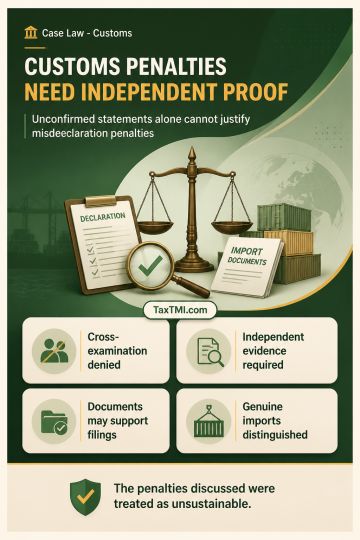
Cross-examination rights and corroborated evidence limit customs penalties for misdeclaration in genuine import transactions involving documented clea...
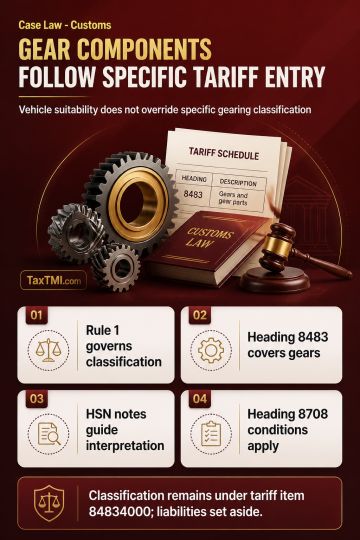
Tariff classification of vehicle gear components follows the specific gearing entry, displacing motor-vehicle parts classification and related liabili...
Necessary-party requirements limit impleadment of independent entities, while deferred consideration does not create an appealable adverse determinati...
Food supplement classification requires common parlance and authoritative tests, preventing treatment as proprietary Ayurvedic medicines without suppo...
Specified regulatory authority income receives conditional tax exemption, subject to non-commercial activity, unchanged income character, and return f...
Tax exemption for regulatory authority income applies retrospectively, subject to non-commercial activity, unchanged income sources, and return-filing...
Page of 4796
Press 'Enter' after typing page number.
601 to 620 of 95918 Results
❮
❯
❯❯
0 / 200
Expand Note
Add to Folder
No Folders have been created
+
Are you sure you want to delete "My most important" ?
Related-party imports allow rejection of declared transaction value where common family control creates a reasonable doubt about the truth and accuracy of the price, and proof of additional cash payment is not required once that doubt arises. After rejection, customs valuation must follow the prescribed methods sequentially, and the authority cannot apply multiple rules at once or switch between rules for different goods without showing why earlier methods failed for each consignment. Residual valuation cannot be based on arbitrary figures such as assumed average undervaluation, export-country prices, or domestic sale prices when those do not fit the valuation scheme. On that basis, consequential duty, confiscation, fine, interest and penalties cannot stand if the re-determined value is unsustainable.
Related-party imports allow rejection of declared transaction value where common family control creates a reasonable doubt about the truth and accuracy of the price, and proof of additional cash payment is not required once that doubt arises. After rejection, customs valuation must follow the prescribed methods sequentially, and the authority cannot apply multiple rules at once or switch between rules for different goods without showing why earlier methods failed for each consignment. Residual valuation cannot be based on arbitrary figures such as assumed average undervaluation, export-country prices, or domestic sale prices when those do not fit the valuation scheme. On that basis, consequential duty, confiscation, fine, interest and penalties cannot stand if the re-determined value is unsustainable.
Note: It is a system-generated summary and is for quick reference only.
 TaxTMI
 of 4796


















 Join Channel


 TaxTMI

