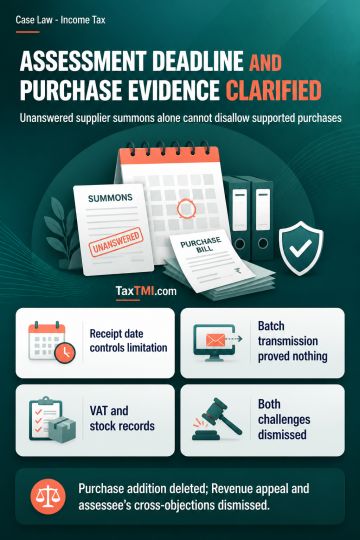
Limitation for consequential assessments runs from prescribed authority receipt, while verified purchases cannot be disallowed merely for unanswered s...
Higher depreciation for qualifying commercial vehicles, exempt-income disallowance, research deduction verification, and club-expense treatment clarif...
Charitable registration renewal cannot become an assessment of receipts, profitability or annual exemption compliance, requiring renewal and donation ...
AMP expenditure for own business is not an international transaction without an associated-enterprise arrangement, eliminating transfer pricing adjust...
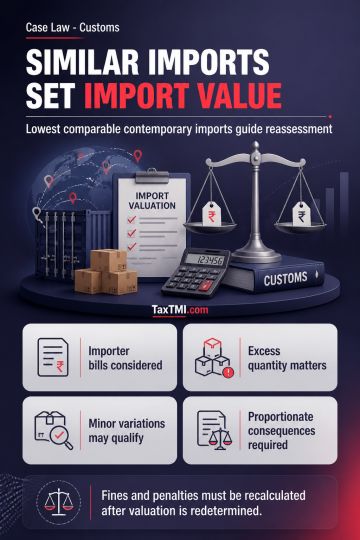
Customs valuation must use comparable contemporary imports, while confiscation fines and penalties require proportionate recalculation on reassessed v...
Page of 4805
Press 'Enter' after typing page number.
61 to 80 of 96092 Results
❮
❯
❯❯
0 / 200
Expand Note
Add to Folder
No Folders have been created
+
Are you sure you want to delete "My most important" ?
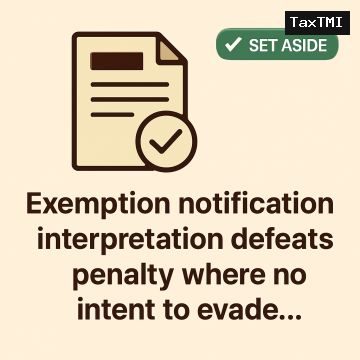
Applicability of Notification No. 20/98-CE to clearances by a 100% EOU turned on interpretation of the exemption conditions, not on fraud or suppression. Once the Larger Bench had settled the notification's applicability to the relevant DTA clearances, the only surviving issue was whether the remaining notification conditions were satisfied. Because the dispute was interpretational and no intent to evade duty was established, the ingredients for penalty under Section 11AC read with Rule 25 were absent. The penalties were therefore correctly set aside, and the remand was confined to verification of fulfilment of the notification conditions and consequential duty liability.
Applicability of Notification No. 20/98-CE to clearances by a 100% EOU turned on interpretation of the exemption conditions, not on fraud or suppression. Once the Larger Bench had settled the notification's applicability to the relevant DTA clearances, the only surviving issue was whether the remaining notification conditions were satisfied. Because the dispute was interpretational and no intent to evade duty was established, the ingredients for penalty under Section 11AC read with Rule 25 were absent. The penalties were therefore correctly set aside, and the remand was confined to verification of fulfilment of the notification conditions and consequential duty liability.
Note: It is a system-generated summary and is for quick reference only.
 TaxTMI
 of 4805





















 Join Channel


 TaxTMI