Transfer pricing and tax deductions upheld on established principles, while employee contributions and warranty provisions returned for fresh examinat...
Captive transfer pricing relies on industrial consumer tariffs, while genuine quotations can benchmark effluent treatment transfers under the Other Me...
Specific tariff classification for ophthalmic instruments and extended limitation principles determine the treatment of duty demands, confiscation, an...
Integrated golf function determines classification, placing launch monitors and simulators under other golf equipment rather than measuring instrument...
Public servant status under anti-corruption law extends to recognised stock exchange leadership; constitutional and sanction challenges do not succeed...
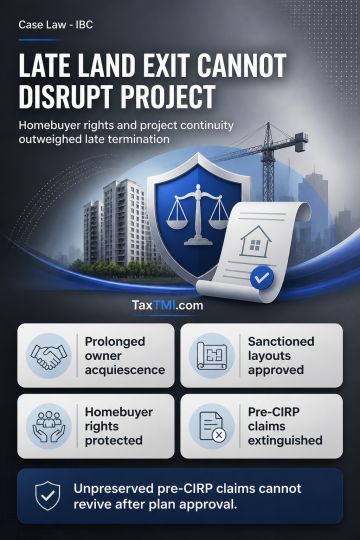
Acquiescence, homebuyer protection and clean-slate resolution principles prevent landowners from disrupting an integrated project through late termina...
Page of 4792
Press 'Enter' after typing page number.
1001 to 1020 of 95833 Results
❮
❯
❯❯
0 / 200
Expand Note
Add to Folder
No Folders have been created
+
Are you sure you want to delete "My most important" ?
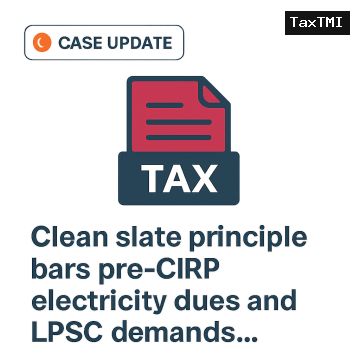
Clean slate principle bars revival of pre-CIRP electricity dues and the connected late payment surcharge after approval of a resolution plan. Where the surcharge had already arisen on unpaid electricity charges before CIRP, extinguishment of the principal pre-resolution claim also prevents indirect recovery of the related surcharge as a condition for restoring supply. Reliance on post-disconnection billing or section 56(2) concepts was misplaced because the liability had already been billed and formed part of the pre-CIRP dues. A demand for pre-CIRP surcharge as a precondition to a fresh electricity connection was therefore treated as arbitrary and without authority of law.
Clean slate principle bars revival of pre-CIRP electricity dues and the connected late payment surcharge after approval of a resolution plan. Where the surcharge had already arisen on unpaid electricity charges before CIRP, extinguishment of the principal pre-resolution claim also prevents indirect recovery of the related surcharge as a condition for restoring supply. Reliance on post-disconnection billing or section 56(2) concepts was misplaced because the liability had already been billed and formed part of the pre-CIRP dues. A demand for pre-CIRP surcharge as a precondition to a fresh electricity connection was therefore treated as arbitrary and without authority of law.
Note: It is a system-generated summary and is for quick reference only.
 TaxTMI
 of 4792




















 Join Channel


 TaxTMI