Transfer pricing and tax deductions upheld on established principles, while employee contributions and warranty provisions returned for fresh examinat...
Captive transfer pricing relies on industrial consumer tariffs, while genuine quotations can benchmark effluent treatment transfers under the Other Me...
Specific tariff classification for ophthalmic instruments and extended limitation principles determine the treatment of duty demands, confiscation, an...
Integrated golf function determines classification, placing launch monitors and simulators under other golf equipment rather than measuring instrument...
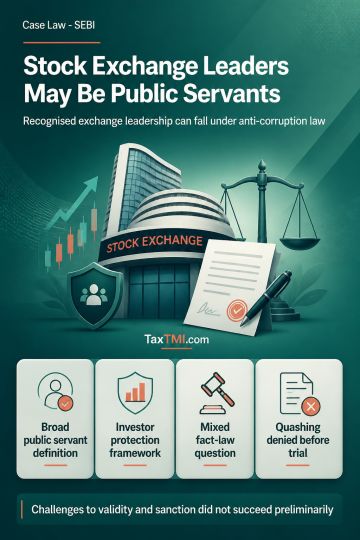
Public servant status under anti-corruption law extends to recognised stock exchange leadership; constitutional and sanction challenges do not succeed...
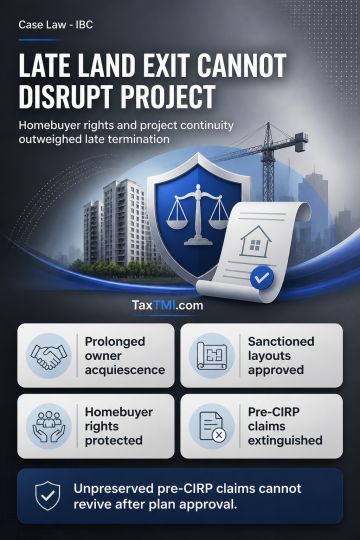
Acquiescence, homebuyer protection and clean-slate resolution principles prevent landowners from disrupting an integrated project through late termina...
Page of 4792
Press 'Enter' after typing page number.
1001 to 1020 of 95833 Results
❮
❯
❯❯
0 / 200
Expand Note
Add to Folder
No Folders have been created
+
Are you sure you want to delete "My most important" ?
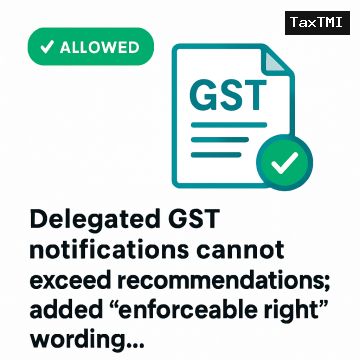
GST notifications issued under Sections 9 and 11 operate as subordinate legislation and cannot travel beyond the GST Council's recommendation. The HC held that the impugned notifications were ultra vires only to the extent they added the expression "enforceable right in a court of law", because that phrase went beyond the recommendation's reference to an actionable claim; the remaining part of the notifications stayed valid. It further held that the GST Council has no constitutional power of ratification under Article 279A, so the 22nd meeting could not cure the unsupported addition and was without jurisdiction. The writ petitions were allowed and notices founded on the invalid part were set aside, with liberty to issue fresh notices in line with the sustained notifications.
GST notifications issued under Sections 9 and 11 operate as subordinate legislation and cannot travel beyond the GST Council's recommendation. The HC held that the impugned notifications were ultra vires only to the extent they added the expression "enforceable right in a court of law", because that phrase went beyond the recommendation's reference to an actionable claim; the remaining part of the notifications stayed valid. It further held that the GST Council has no constitutional power of ratification under Article 279A, so the 22nd meeting could not cure the unsupported addition and was without jurisdiction. The writ petitions were allowed and notices founded on the invalid part were set aside, with liberty to issue fresh notices in line with the sustained notifications.
Note: It is a system-generated summary and is for quick reference only.
 TaxTMI
 of 4792

















 Join Channel


 TaxTMI