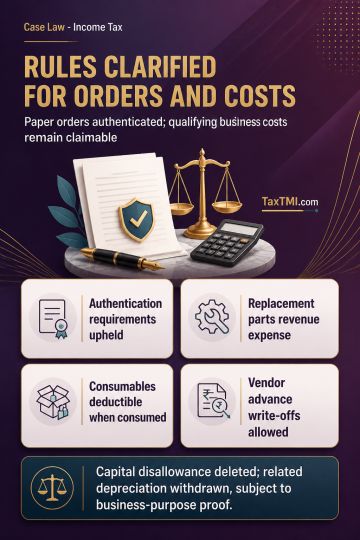
Authentication of paper assessment orders upheld, while qualifying repairs, consumables and vendor advance write-offs remain deductible business claim...
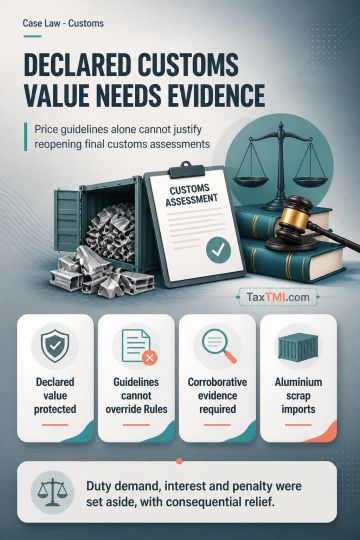
Transaction value cannot be rejected solely on non-statutory valuation guidelines without corroborative evidence supporting reassessment of final cust...
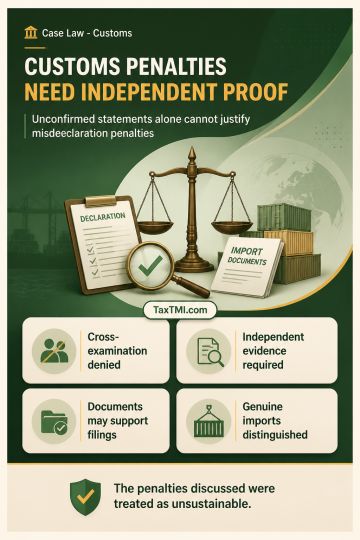
Cross-examination rights and corroborated evidence limit customs penalties for misdeclaration in genuine import transactions involving documented clea...
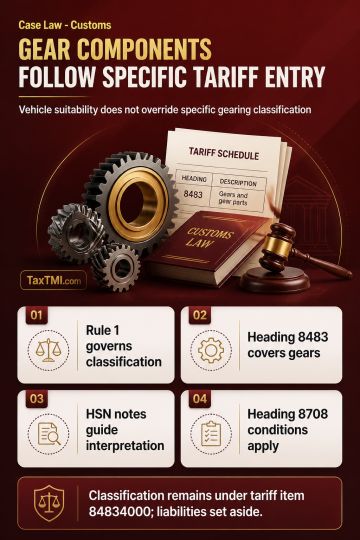
Tariff classification of vehicle gear components follows the specific gearing entry, displacing motor-vehicle parts classification and related liabili...
Page of 4794
Press 'Enter' after typing page number.
541 to 560 of 95875 Results
❮
❯
❯❯
0 / 200
Expand Note
Add to Folder
No Folders have been created
+
Are you sure you want to delete "My most important" ?
GST notifications issued under Sections 9 and 11 operate as subordinate legislation and cannot travel beyond the GST Council's recommendation. The HC held that the impugned notifications were ultra vires only to the extent they added the expression "enforceable right in a court of law", because that phrase went beyond the recommendation's reference to an actionable claim; the remaining part of the notifications stayed valid. It further held that the GST Council has no constitutional power of ratification under Article 279A, so the 22nd meeting could not cure the unsupported addition and was without jurisdiction. The writ petitions were allowed and notices founded on the invalid part were set aside, with liberty to issue fresh notices in line with the sustained notifications.
GST notifications issued under Sections 9 and 11 operate as subordinate legislation and cannot travel beyond the GST Council's recommendation. The HC held that the impugned notifications were ultra vires only to the extent they added the expression "enforceable right in a court of law", because that phrase went beyond the recommendation's reference to an actionable claim; the remaining part of the notifications stayed valid. It further held that the GST Council has no constitutional power of ratification under Article 279A, so the 22nd meeting could not cure the unsupported addition and was without jurisdiction. The writ petitions were allowed and notices founded on the invalid part were set aside, with liberty to issue fresh notices in line with the sustained notifications.
Note: It is a system-generated summary and is for quick reference only.
 TaxTMI
 of 4794



 Join Channel


 TaxTMI