Tax exemption for regulatory authority income applies retrospectively, subject to non-commercial activity, unchanged income sources, and return filing...
Dispute Resolution Panel objections must reach both prescribed forums; otherwise assessment may proceed and statutory appeal remains the proper remedy...
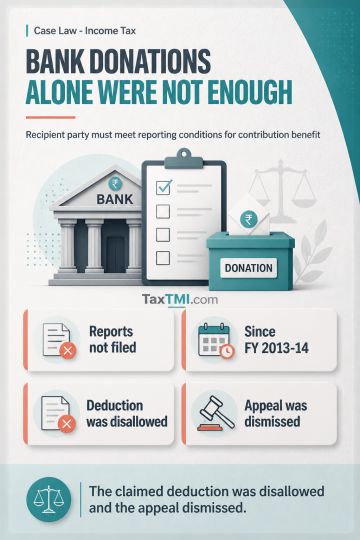
Political contribution deductions require recipient party compliance with contribution-reporting conditions; banking-channel donations alone do not qu...
Aggregation under TNMM prevents selective testing of intra-group services without comparable uncontrolled transactions, while appellate additional cla...
Protective assessment cannot duplicate identical receipts under competing characterisations; remote services did not establish a taxable permanent est...
Page of 4792
Press 'Enter' after typing page number.
461 to 480 of 95833 Results
❮
❯
❯❯
0 / 200
Expand Note
Add to Folder
No Folders have been created
+
Are you sure you want to delete "My most important" ?
Reward under the informant guidelines was treated as ex gratia and subject to the competent authority's discretion, with relaxation beyond the prescribed ceiling resting with the Full Board. The informant had accepted that the payment was non-contractual and would not be challenged in court. After re-examining the tax recovery, supplied information and weightage methodology, the Board recalculated the reward and found the earlier recommendation incorrect. The Court declined to substitute its own assessment, holding that writ interference was unavailable absent manifest illegality or patent arbitrariness. The enhanced claim was rejected and the writ petition dismissed.
Reward under the informant guidelines was treated as ex gratia and subject to the competent authority's discretion, with relaxation beyond the prescribed ceiling resting with the Full Board. The informant had accepted that the payment was non-contractual and would not be challenged in court. After re-examining the tax recovery, supplied information and weightage methodology, the Board recalculated the reward and found the earlier recommendation incorrect. The Court declined to substitute its own assessment, holding that writ interference was unavailable absent manifest illegality or patent arbitrariness. The enhanced claim was rejected and the writ petition dismissed.
Note: It is a system-generated summary and is for quick reference only.
 TaxTMI
 of 4792
















 Join Channel



 TaxTMI