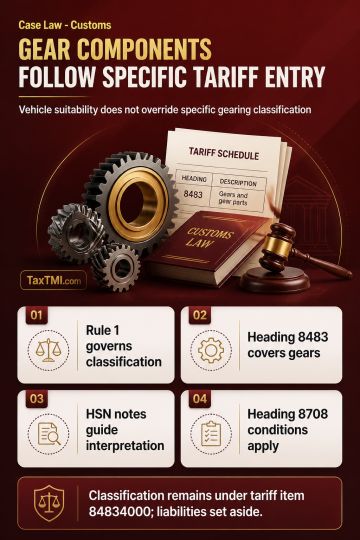
Tariff classification of vehicle gear components follows the specific gearing entry, displacing motor-vehicle parts classification and related liabili...
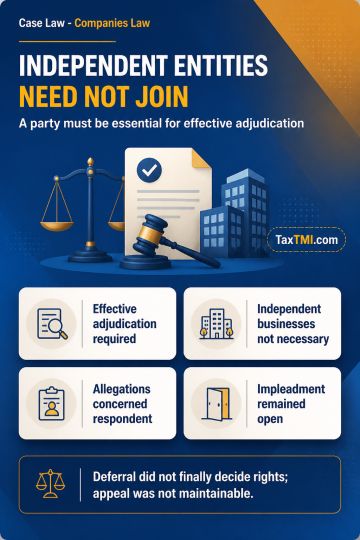
Necessary-party requirements limit impleadment of independent entities, while deferred consideration does not create an appealable adverse determinati...
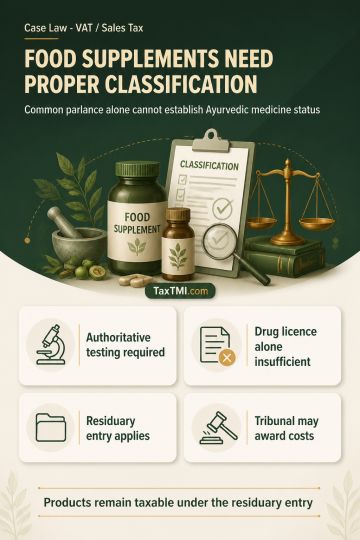
Food supplement classification requires common parlance and authoritative tests, preventing treatment as proprietary Ayurvedic medicines without suppo...
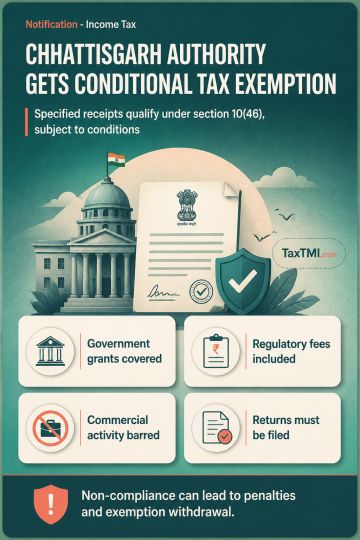
Specified regulatory authority income receives conditional tax exemption, subject to non-commercial activity, unchanged income character, and return f...
Tax exemption for regulatory authority income applies retrospectively, subject to non-commercial activity, unchanged income sources, and return-filing...
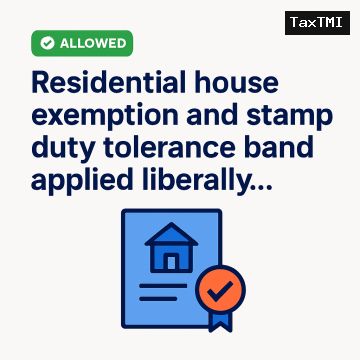
ITAT treated the exemption for capital gains invested in purchase of a plot and construction of a residential house as a beneficial provision requiring liberal, purposive construction. It held that once investment in acquisition and construction was established, strict insistence on a completion certificate or full completion within the period was not the sole test, and COVID-19 disruptions justified the delay; substantial compliance was enough, so the disallowance was unjustified and the exemption had to be allowed. On the stamp duty issue, it held that where the variation between purchase price and stamp duty value was below the enhanced 10% tolerance band, the curative amendment applied and the addition could not survive, so it was deleted.
ITAT treated the exemption for capital gains invested in purchase of a plot and construction of a residential house as a beneficial provision requiring liberal, purposive construction. It held that once investment in acquisition and construction was established, strict insistence on a completion certificate or full completion within the period was not the sole test, and COVID-19 disruptions justified the delay; substantial compliance was enough, so the disallowance was unjustified and the exemption had to be allowed. On the stamp duty issue, it held that where the variation between purchase price and stamp duty value was below the enhanced 10% tolerance band, the curative amendment applied and the addition could not survive, so it was deleted.
Note: It is a system-generated summary and is for quick reference only.
 TaxTMI
 of 4782













 Join Channel


 TaxTMI
