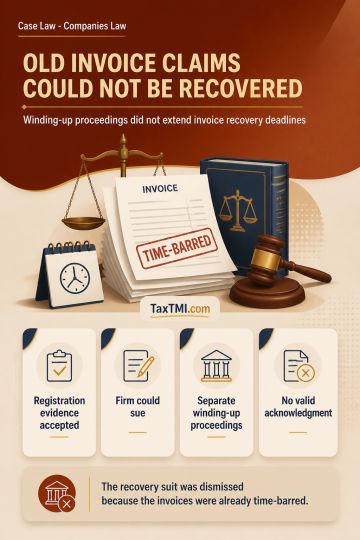
Invoice-based recovery claims remain time-barred despite separate winding-up proceedings, absent valid acknowledgment or part-payment of the disputed ...
Extended limitation fails without specific suppression allegations, while overseas employee secondment remains taxable as manpower supply within norma...
Time-share accommodation classification excludes Club or Association Service where purchasers receive contractual occupancy rights without genuine mem...
CENVAT credit for trading requires reversal, while taxable-service rental credit remains proportionately available and limitation issues await resolut...
Vicarious liability for dishonoured company cheques may extend to non-signatory directors where complaints contain foundational responsibility avermen...
Page of 4805
Press 'Enter' after typing page number.
321 to 340 of 96092 Results
❮
❯
❯❯
0 / 200
Expand Note
Add to Folder
No Folders have been created
+
Are you sure you want to delete "My most important" ?
The Tribunal held that interest received from or paid to head office and overseas branches on the NOSTRO account was a self-to-self transaction governed by mutuality, so it was not taxable in the permanent establishment's hands and the related disallowance failed. On head office expenditure, it restored the matter for fresh examination because the disputed items had to be tested on the Supreme Court's interpretation of the statutory concept of head office expenditure; the royalty issue was to be considered only if the items fell outside that concept. It upheld deletion of the exempt-income disallowance where surplus interest-free funds exceeded the investments, sustained deduction of broken period interest, treated ATM software expenditure as revenue, and held that income taxed on a special gross basis is not exempt income.
The Tribunal held that interest received from or paid to head office and overseas branches on the NOSTRO account was a self-to-self transaction governed by mutuality, so it was not taxable in the permanent establishment's hands and the related disallowance failed. On head office expenditure, it restored the matter for fresh examination because the disputed items had to be tested on the Supreme Court's interpretation of the statutory concept of head office expenditure; the royalty issue was to be considered only if the items fell outside that concept. It upheld deletion of the exempt-income disallowance where surplus interest-free funds exceeded the investments, sustained deduction of broken period interest, treated ATM software expenditure as revenue, and held that income taxed on a special gross basis is not exempt income.
Note: It is a system-generated summary and is for quick reference only.
 TaxTMI
 of 4805










 Join Channel


 TaxTMI

