Corporate guarantee valuation permits actual ascertainable commission while barring retroactive application and extended-period penalties for bona fid...
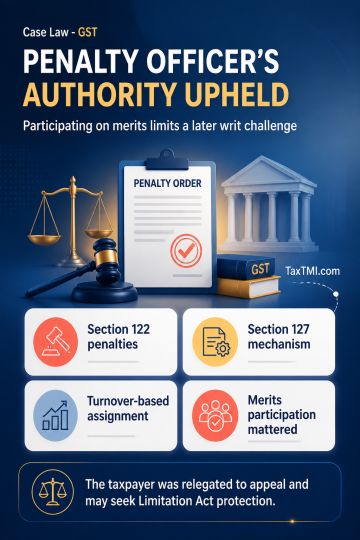
Proper-officer jurisdiction under UPGST penalty provisions upheld; participation on merits prevents bypassing the statutory appellate remedy through w...
Transitioned CENVAT credit may validly satisfy mandatory pre-deposit requirements for legacy service tax appeals through Electronic Credit Ledger debi...
Building-plan sanction charges require statutory authority; unauthorised fees and GST were quashed, while labour cess must follow prescribed collectio...
Pure-agent exclusion fails where hotel booking facilitators receive third-party services themselves, making entire customer consideration taxable as r...
Transfer pricing requires evidence for AMP transactions, functionally reliable comparables, and appropriate aggregation or Berry Ratio benchmarking me...
Revisionary jurisdiction cannot reopen share capital assessments where adequate inquiry supports a permissible view and no independent error is establ...
Page of 4805
Press 'Enter' after typing page number.
221 to 240 of 96092 Results
❮
❯
❯❯
0 / 200
Expand Note
Add to Folder
No Folders have been created
+
Are you sure you want to delete "My most important" ?
On allotment-based acquisition of immovable property, the holding period was held to run from the allotment date where the allotment letter created substantive enforceable rights and substantial consideration had already been paid, so the transfer was taxable as long-term capital gain. The Tribunal also treated additional evidence as admitted once it had been sent for remand comments and considered on merits, and found a separate refusal to admit it self-contradictory. For the immovable-property addition, it accepted substantial compliance with the banking-channel condition, held that the stamp duty value as on the allotment date was the relevant benchmark, and restored the matter only for limited factual verification of that valuation.
On allotment-based acquisition of immovable property, the holding period was held to run from the allotment date where the allotment letter created substantive enforceable rights and substantial consideration had already been paid, so the transfer was taxable as long-term capital gain. The Tribunal also treated additional evidence as admitted once it had been sent for remand comments and considered on merits, and found a separate refusal to admit it self-contradictory. For the immovable-property addition, it accepted substantial compliance with the banking-channel condition, held that the stamp duty value as on the allotment date was the relevant benchmark, and restored the matter only for limited factual verification of that valuation.
Note: It is a system-generated summary and is for quick reference only.
 TaxTMI
 of 4805




















 Join Channel



 TaxTMI