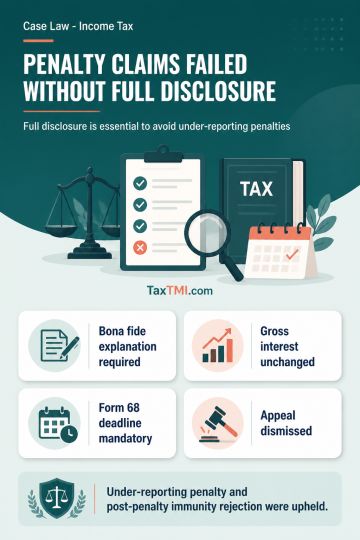
Bona fide disclosure requirements govern under-reporting penalties, and post-penalty immunity applications cannot secure available statutory protectio...
Certificate-of-origin verification procedure governs preferential customs benefits; denial without retroactive verification was set aside with consequ...
Disciplinary Committee jurisdiction and mandatory investigation requirements invalidated cancellation of an insolvency professional's registration and...
Retention of seized property survives where recorded reasons support proceeds of crime, while stayed investigation periods are excluded from limitatio...
Penalty under section 271AAC is discretionary and cannot follow automatically from an addition under section 68. Where unsecured loans were recorded in the books and the addition arose only because the assessee failed to furnish details in an ex parte assessment, mere non-acceptance of the explanation did not by itself justify penalty. Treating penalty proceedings as quasi-criminal, the Tribunal held that a higher standard applies than for making an addition and that technical failure to satisfy the Assessing Officer is insufficient. It therefore deleted the penalty and allowed the appeal.
Penalty under section 271AAC is discretionary and cannot follow automatically from an addition under section 68. Where unsecured loans were recorded in the books and the addition arose only because the assessee failed to furnish details in an ex parte assessment, mere non-acceptance of the explanation did not by itself justify penalty. Treating penalty proceedings as quasi-criminal, the Tribunal held that a higher standard applies than for making an addition and that technical failure to satisfy the Assessing Officer is insufficient. It therefore deleted the penalty and allowed the appeal.
Note: It is a system-generated summary and is for quick reference only.
 TaxTMI
 of 4796


















 Join Channel



 TaxTMI