Business expenditure deduction requires proof of genuine commission payments and commercial allowability; turnover growth alone cannot validate the cl...
Article 8 treaty coverage excluded third-party airline support services, while documented demonetisation cash receipts remained accepted business inco...
Functional comparability under TNMM requires highway contract benchmarks to reflect operation, maintenance and transfer activities, requiring fresh be...
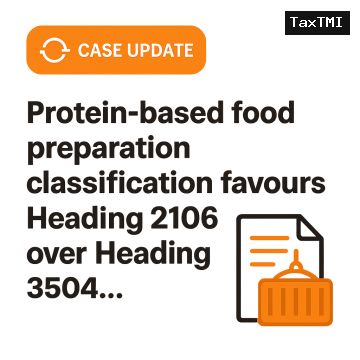
Classification of a fortified soy protein product turned on the tariff terms, Chapter Notes and the General Rules for Interpretation rather than food-standard labels. Although Heading 3504 covers protein isolates, the product's 82% protein content, added calcium phosphate and fortified imported form showed it was not a plain soy protein isolate but a formulated nutritional preparation. The reliance on Codex and FSSAI standards was non-determinative for customs classification. Applying the HSN Notes to Heading 2106 and Chapter Note 5 to Chapter 21, the product was treated as a protein-based food preparation for enrichment of foods and beverages, and tariff item 21061000 was preferred over Heading 3504.
Classification of a fortified soy protein product turned on the tariff terms, Chapter Notes and the General Rules for Interpretation rather than food-standard labels. Although Heading 3504 covers protein isolates, the product's 82% protein content, added calcium phosphate and fortified imported form showed it was not a plain soy protein isolate but a formulated nutritional preparation. The reliance on Codex and FSSAI standards was non-determinative for customs classification. Applying the HSN Notes to Heading 2106 and Chapter Note 5 to Chapter 21, the product was treated as a protein-based food preparation for enrichment of foods and beverages, and tariff item 21061000 was preferred over Heading 3504.
Note: It is a system-generated summary and is for quick reference only.
 TaxTMI
 of 4803















 Join Channel


 TaxTMI