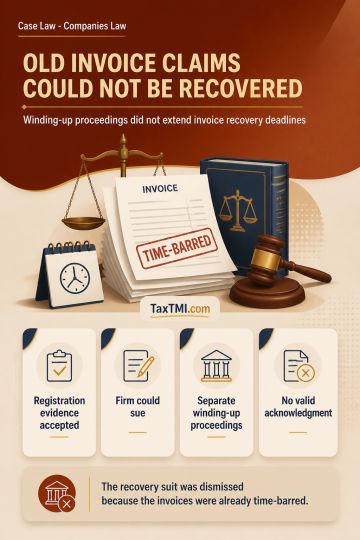
Invoice-based recovery claims remain time-barred despite separate winding-up proceedings, absent valid acknowledgment or part-payment of the disputed ...
Extended limitation fails without specific suppression allegations, while overseas employee secondment remains taxable as manpower supply within norma...
Time-share accommodation classification excludes Club or Association Service where purchasers receive contractual occupancy rights without genuine mem...
CENVAT credit for trading requires reversal, while taxable-service rental credit remains proportionately available and limitation issues await resolut...
Vicarious liability for dishonoured company cheques may extend to non-signatory directors where complaints contain foundational responsibility avermen...
Page of 4805
Press 'Enter' after typing page number.
321 to 340 of 96092 Results
❮
❯
❯❯
0 / 200
Expand Note
Add to Folder
No Folders have been created
+
Are you sure you want to delete "My most important" ?
A short-deduction demand on purchase of immovable property was held unsustainable where the seller's PAN was later regularised through Aadhaar linkage within the CBDT circular period, so the higher TDS rate for an inoperative PAN did not apply and the related demand under section 200A had to be deleted. Independently, the proviso to section 201(1) protected the deductor because the seller had filed the return, declared the capital gains, and paid tax on the transaction, so the deductor could not be treated as an assessee-in-default. The Tribunal also noted that similar relief had already been granted in the co-owner's case.
A short-deduction demand on purchase of immovable property was held unsustainable where the seller's PAN was later regularised through Aadhaar linkage within the CBDT circular period, so the higher TDS rate for an inoperative PAN did not apply and the related demand under section 200A had to be deleted. Independently, the proviso to section 201(1) protected the deductor because the seller had filed the return, declared the capital gains, and paid tax on the transaction, so the deductor could not be treated as an assessee-in-default. The Tribunal also noted that similar relief had already been granted in the co-owner's case.
Note: It is a system-generated summary and is for quick reference only.
 TaxTMI
 of 4805

















 Join Channel


 TaxTMI

