Accredited investor eligibility expands through securities-market exposure, while alternative investment fund disputes require prescribed resolution a...
Customs Assessment Portal centralises classification and valuation guidance to support consistent, transparent and informed compliance across stakehol...
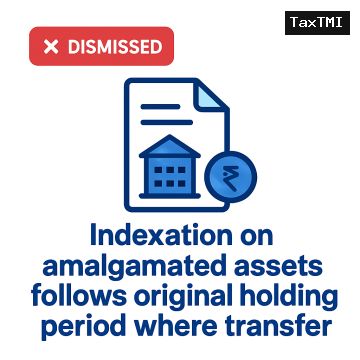
Indexation on a capital asset received in amalgamation was held to run from FY 2008-09 because the township had already been constructed and let out by the amalgamating company, with rental income taxed from that year; the tax-neutral transfer under the scheme did not shift the holding period to the later amalgamation order or occupancy certificate. The Tribunal also upheld the claimed short-term capital loss on sale of AIF units to a subsidiary, finding both acquisition and sale valuations followed the NAV method, the fall in value was explained by decline in underlying investments, and a related-party sale is not a colourable device without evidence of tax avoidance. Both revenue appeals were dismissed.
Indexation on a capital asset received in amalgamation was held to run from FY 2008-09 because the township had already been constructed and let out by the amalgamating company, with rental income taxed from that year; the tax-neutral transfer under the scheme did not shift the holding period to the later amalgamation order or occupancy certificate. The Tribunal also upheld the claimed short-term capital loss on sale of AIF units to a subsidiary, finding both acquisition and sale valuations followed the NAV method, the fall in value was explained by decline in underlying investments, and a related-party sale is not a colourable device without evidence of tax avoidance. Both revenue appeals were dismissed.
Note: It is a system-generated summary and is for quick reference only.
 TaxTMI
  TaxTMI
 of 4921