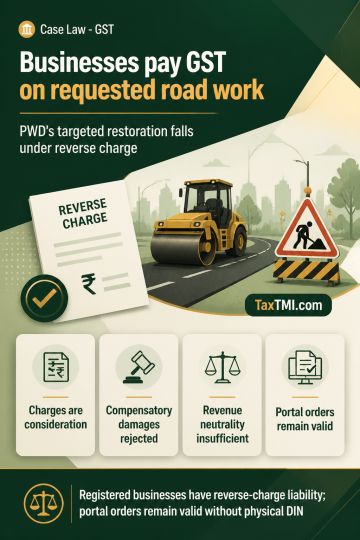
Request-driven road restoration attracts reverse-charge GST, not governmental-function treatment or compensatory-damages status for business recipient...
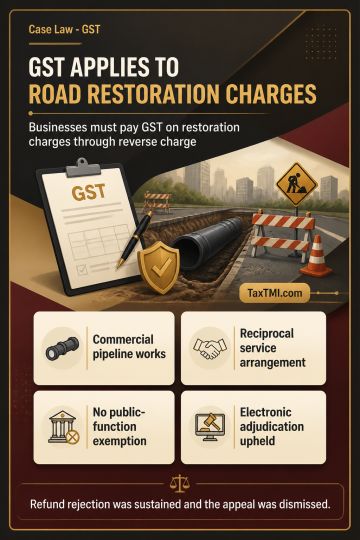
Road restoration charges for commercial pipeline works are taxable Government services, with reverse charge liability and no public-function exemption...
Model-wise import cap monitoring cannot justify withholding used multifunction machines where all-India tracking is absent and full security is furnis...
A liquidation auction for sale of a corporate debtor as a going concern was confined to the corporate debtor on an as is where is, as is what is, whatever there is and no recourse basis, and an alleged business plan could not enlarge the sale to include subsidiaries, joint ventures, associates or other third-party assets. The text notes that such assets were not shown to form part of the liquidation estate, and the prayers for restraint against alienation and for further extension or amendment of the payment schedule were rejected. Cancellation of the bid for non-payment was upheld, but the forfeiture of deposited sums remained unresolved because the Members differed on that limited issue.
A liquidation auction for sale of a corporate debtor as a going concern was confined to the corporate debtor on an as is where is, as is what is, whatever there is and no recourse basis, and an alleged business plan could not enlarge the sale to include subsidiaries, joint ventures, associates or other third-party assets. The text notes that such assets were not shown to form part of the liquidation estate, and the prayers for restraint against alienation and for further extension or amendment of the payment schedule were rejected. Cancellation of the bid for non-payment was upheld, but the forfeiture of deposited sums remained unresolved because the Members differed on that limited issue.
Note: It is a system-generated summary and is for quick reference only.
 TaxTMI
  TaxTMI
 of 4918