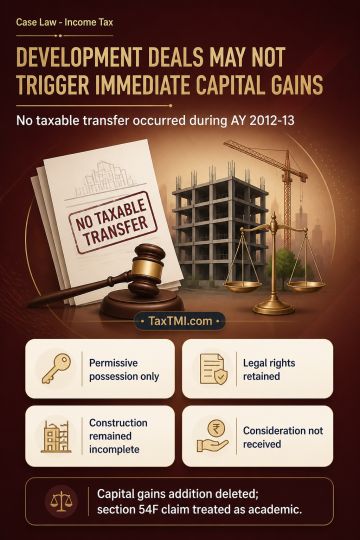
Development agreements require legal possession or effective enjoyment for capital gains transfer; permissive possession and deferred consideration de...
Prolonged sterilisation of development rights supports capital-gains treatment, while business-income disallowances cannot govern capital-gains comput...
Additional evidence in transfer pricing dispute leads to fresh examination, while tax deductions, TDS credit, fee and refund interest require verifica...
Category II AIF pass-through taxation preserves non-business income character; investment receipts cannot be reclassified without applying recognised ...
In cheque dishonour proceedings, once issuance of the cheque and the signature are admitted or proved, a reverse onus arises and the law presumes that the cheque was issued towards a legally enforceable debt or liability; the accused must rebut that presumption by a probable defence supported by cogent material, and a bare denial or vague explanation is insufficient. Dishonour on stop-payment instructions can still attract penal consequences where the cheque was presented within validity, returned unpaid, notice was issued in time, and payment was not made. On that basis, the acquittal was set aside and the complaint cases were remanded for fresh adjudication.
In cheque dishonour proceedings, once issuance of the cheque and the signature are admitted or proved, a reverse onus arises and the law presumes that the cheque was issued towards a legally enforceable debt or liability; the accused must rebut that presumption by a probable defence supported by cogent material, and a bare denial or vague explanation is insufficient. Dishonour on stop-payment instructions can still attract penal consequences where the cheque was presented within validity, returned unpaid, notice was issued in time, and payment was not made. On that basis, the acquittal was set aside and the complaint cases were remanded for fresh adjudication.
Note: It is a system-generated summary and is for quick reference only.
 TaxTMI
 of 4800










 Join Channel


 TaxTMI
