Retention of seized property survives where recorded reasons support proceeds of crime, while stayed investigation periods are excluded from limitatio...
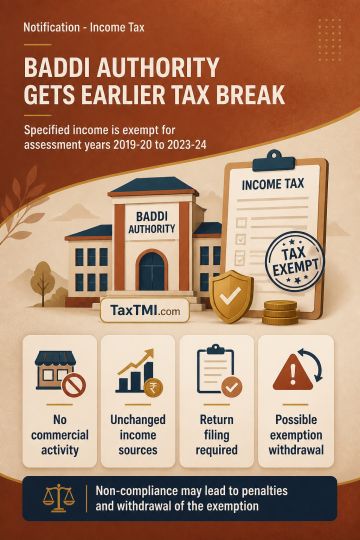
Specified income of Baddi Barotiwala Nalagarh Development Authority receives conditional tax exemption, retrospectively covering its designated assess...
Specified development authority income receives retrospective tax exemption, subject to non-commercial activity, unchanged income sources, and return-...
Unified Brand India framework introduces voluntary Trust Mark certification and funding support for export branding, packaging and global promotional ...
Origin Declaration authentication governs preferential tariff claims under India-UK CETA, requiring a validated reference number before import clearan...
Separate assessment orders for different years remain valid when distinct notices and hearing opportunities prevent prejudice from combined proceeding...
One-time settlement paid to contractors was treated as revenue business expenditure incurred wholly and exclusively for business purposes; the Tribunal accepted that the contractors remained responsible for their workers, tax was deducted at source, and the payments were made to avoid disruption during restructuring, so the full deduction was allowed and the four-fifths disallowance deleted. The disallowance linked to exempt income was remitted because the Assessing Officer proceeded on the mistaken assumption that no suo motu disallowance existed, while the assessee had not fully supported its computation, requiring fresh examination after considering the computation and further material. The treaty-rate claim on dividend distribution tax was admitted as a pure legal ground and remitted for decision after the Supreme Court's final ruling on the controversy.
One-time settlement paid to contractors was treated as revenue business expenditure incurred wholly and exclusively for business purposes; the Tribunal accepted that the contractors remained responsible for their workers, tax was deducted at source, and the payments were made to avoid disruption during restructuring, so the full deduction was allowed and the four-fifths disallowance deleted. The disallowance linked to exempt income was remitted because the Assessing Officer proceeded on the mistaken assumption that no suo motu disallowance existed, while the assessee had not fully supported its computation, requiring fresh examination after considering the computation and further material. The treaty-rate claim on dividend distribution tax was admitted as a pure legal ground and remitted for decision after the Supreme Court's final ruling on the controversy.
Note: It is a system-generated summary and is for quick reference only.
 TaxTMI
 of 4801

















 Join Channel


 TaxTMI

