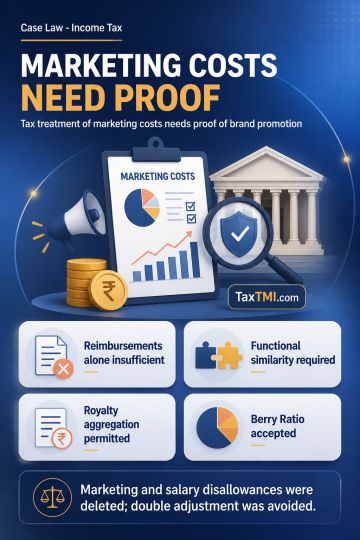
Transfer pricing requires evidence for AMP transactions, functionally reliable comparables, and appropriate aggregation or Berry Ratio benchmarking me...
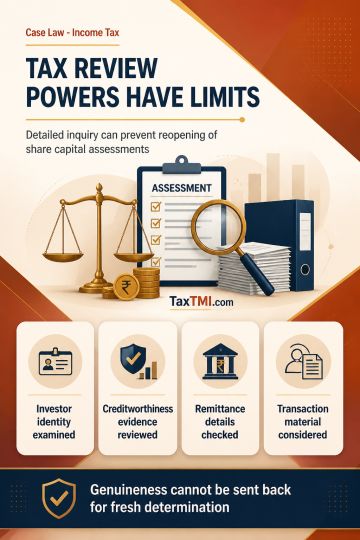
Revisionary jurisdiction cannot reopen share capital assessments where adequate inquiry supports a permissible view and no independent error is establ...
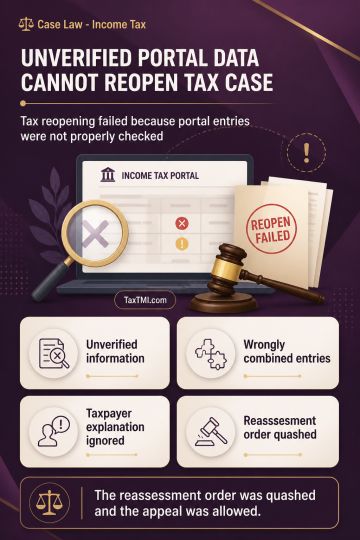
Reassessment jurisdiction fails where unverified portal information is aggregated without examining the taxpayer's explanation or relevance of entries...
Statutory sanction for delayed reassessment requires approval from the prescribed authority; approval by an inferior authority invalidates jurisdictio...
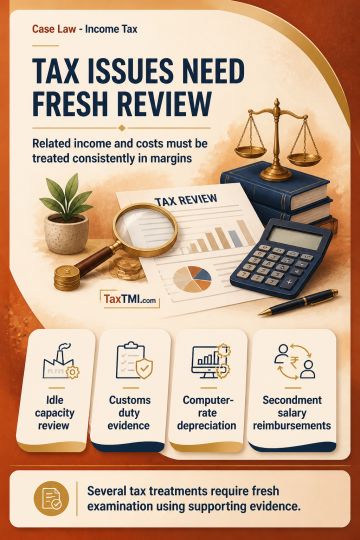
Transfer pricing margin adjustments require matching treatment of non-operating income and related costs, with comparability issues reconsidered on ev...
Preliminary-expense amortisation and MAT exempt-income adjustments prevailed, while trademark costs and managerial remuneration require fresh verifica...
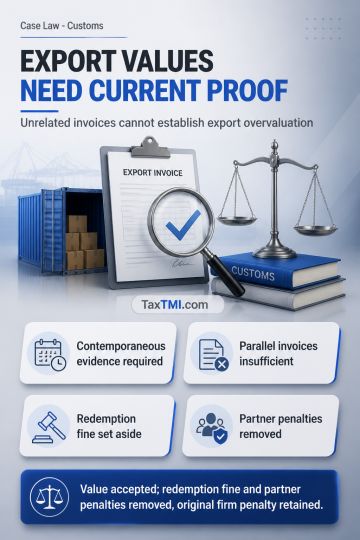
Export valuation requires contemporaneous evidence; unrelated invoices cannot prove overvaluation, and dual penalties on firm and partner are impermis...
One-time settlement paid to contractors was treated as revenue business expenditure incurred wholly and exclusively for business purposes; the Tribunal accepted that the contractors remained responsible for their workers, tax was deducted at source, and the payments were made to avoid disruption during restructuring, so the full deduction was allowed and the four-fifths disallowance deleted. The disallowance linked to exempt income was remitted because the Assessing Officer proceeded on the mistaken assumption that no suo motu disallowance existed, while the assessee had not fully supported its computation, requiring fresh examination after considering the computation and further material. The treaty-rate claim on dividend distribution tax was admitted as a pure legal ground and remitted for decision after the Supreme Court's final ruling on the controversy.
One-time settlement paid to contractors was treated as revenue business expenditure incurred wholly and exclusively for business purposes; the Tribunal accepted that the contractors remained responsible for their workers, tax was deducted at source, and the payments were made to avoid disruption during restructuring, so the full deduction was allowed and the four-fifths disallowance deleted. The disallowance linked to exempt income was remitted because the Assessing Officer proceeded on the mistaken assumption that no suo motu disallowance existed, while the assessee had not fully supported its computation, requiring fresh examination after considering the computation and further material. The treaty-rate claim on dividend distribution tax was admitted as a pure legal ground and remitted for decision after the Supreme Court's final ruling on the controversy.
Note: It is a system-generated summary and is for quick reference only.
 TaxTMI
 of 4805















 Join Channel


 TaxTMI
