Certificate-of-origin verification procedure governs preferential customs benefits; denial without retroactive verification was set aside with consequ...
Disciplinary Committee jurisdiction and mandatory investigation requirements invalidated cancellation of an insolvency professional's registration and...
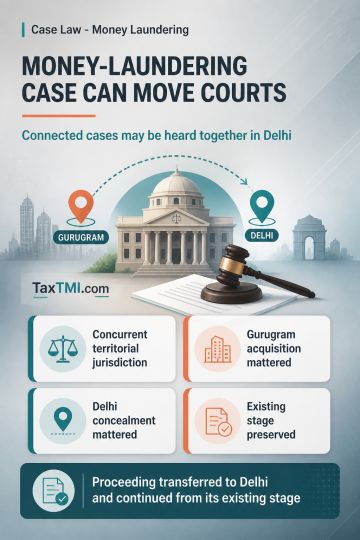
Retention of seized property survives where recorded reasons support proceeds of crime, while stayed investigation periods are excluded from limitatio...
Specified income of Baddi Barotiwala Nalagarh Development Authority receives conditional tax exemption, retrospectively covering its designated assess...
Specified development authority income receives retrospective tax exemption, subject to non-commercial activity, unchanged income sources, and return-...
Unified Brand India framework introduces voluntary Trust Mark certification and funding support for export branding, packaging and global promotional ...
Transfer pricing benchmarking had to be confined to the assessee's international transactions where segmental results for associated enterprise and non-associated enterprise dealings were available and capable of segregation. Entity-level margins could not be used merely because the segmental accounts were unaudited, and the benchmarking was therefore directed to be on segmental profitability. In applying external TNMM, comparables had to satisfy functional, asset and risk similarity; retail businesses, fabric or yarn manufacturers, contract socks manufacturers, leather garment manufacturers, and companies with merger or acquisition during the year were excluded, and exporters with export revenue below 75% of sales were also filtered out. The TPO was directed to redo comparability analysis and allow the +/- 5% tolerance under section 92C(2).
Transfer pricing benchmarking had to be confined to the assessee's international transactions where segmental results for associated enterprise and non-associated enterprise dealings were available and capable of segregation. Entity-level margins could not be used merely because the segmental accounts were unaudited, and the benchmarking was therefore directed to be on segmental profitability. In applying external TNMM, comparables had to satisfy functional, asset and risk similarity; retail businesses, fabric or yarn manufacturers, contract socks manufacturers, leather garment manufacturers, and companies with merger or acquisition during the year were excluded, and exporters with export revenue below 75% of sales were also filtered out. The TPO was directed to redo comparability analysis and allow the +/- 5% tolerance under section 92C(2).
Note: It is a system-generated summary and is for quick reference only.
 TaxTMI
 of 4803




















 Join Channel


 TaxTMI

