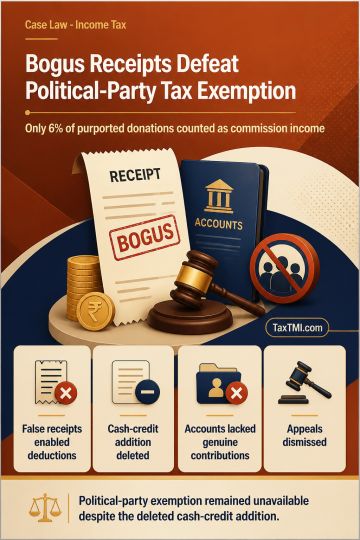
Bogus donation receipts justified commission income assessment and defeated political-party tax exemption for inaccurate accounts and reporting failur...
Pure reimbursement without income element escapes tax withholding, while delayed withholding and unsupported provisions face deferred or renewed scrut...
Public benefit requirement defeats charitable registration where residents' association services are reciprocal, member-only facilities governed by mu...
Exempt-income expenditure disallowance is confined to investments that actually generated exempt income, while supported business expenses remain dedu...
Objective characteristics and principal use govern mining-tyre classification, while fresh advance ruling applications may rely on additional technica...
Page of 4805
Press 'Enter' after typing page number.
801 to 820 of 96092 Results
❮
❯
❯❯
0 / 200
Expand Note
Add to Folder
No Folders have been created
+
Are you sure you want to delete "My most important" ?
HC held that cancellation of GST registration and rejection of the revocation application were vitiated by breach of natural justice. The authority had invited and received a reply but rejected it by a cryptic order without addressing the defence or recording reasons, making the decision arbitrary and non-speaking. The cancellation and revocation notices were also defective because the hearing date was fixed before expiry of the time granted to reply, denying a meaningful opportunity of hearing. Although the general rule favours the statutory appellate remedy, writ jurisdiction under Article 226 remained available where the impugned orders were patently illegal, arbitrary, or passed without fair hearing. The impugned orders were set aside and the writ petition was entertained.
HC held that cancellation of GST registration and rejection of the revocation application were vitiated by breach of natural justice. The authority had invited and received a reply but rejected it by a cryptic order without addressing the defence or recording reasons, making the decision arbitrary and non-speaking. The cancellation and revocation notices were also defective because the hearing date was fixed before expiry of the time granted to reply, denying a meaningful opportunity of hearing. Although the general rule favours the statutory appellate remedy, writ jurisdiction under Article 226 remained available where the impugned orders were patently illegal, arbitrary, or passed without fair hearing. The impugned orders were set aside and the writ petition was entertained.
Note: It is a system-generated summary and is for quick reference only.
 TaxTMI
 of 4805


















 Join Channel


 TaxTMI