Revisionary jurisdiction cannot reopen share capital assessments where adequate inquiry supports a permissible view and no independent error is establ...
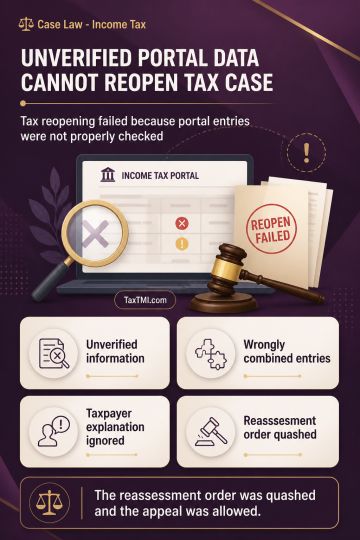
Reassessment jurisdiction fails where unverified portal information is aggregated without examining the taxpayer's explanation or relevance of entries...
Statutory sanction for delayed reassessment requires approval from the prescribed authority; approval by an inferior authority invalidates jurisdictio...
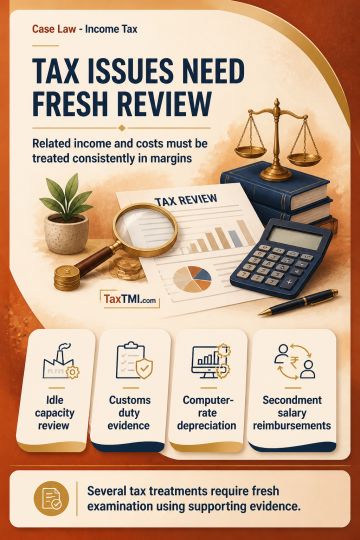
Transfer pricing margin adjustments require matching treatment of non-operating income and related costs, with comparability issues reconsidered on ev...
Preliminary-expense amortisation and MAT exempt-income adjustments prevailed, while trademark costs and managerial remuneration require fresh verifica...
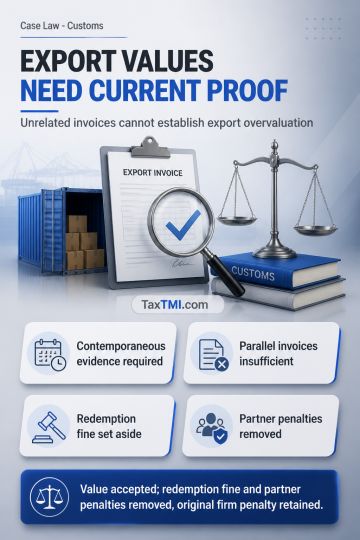
Export valuation requires contemporaneous evidence; unrelated invoices cannot prove overvaluation, and dual penalties on firm and partner are impermis...
Ratification of resignation acceptance validates separation retrospectively, while withdrawal may be refused through reasoned administrative discretio...
Page of 4809
Press 'Enter' after typing page number.
321 to 340 of 96174 Results
❮
❯
❯❯
0 / 200
Expand Note
Add to Folder
No Folders have been created
+
Are you sure you want to delete "My most important" ?
For a transaction to be treated as inter-State sale under section 3(a) of the CST Act, the movement of goods must be occasioned by a prior contract of sale. On the agency agreement effective from 01.08.1995, the goods remained the principal's property, the agent sold on behalf of the principal, and the appellant discharged the initial burden under section 6A by producing documents and Form F declarations. The CESTAT erred in relying on pre-agreement material to characterise later movements as sales, so the post-01.08.1995 turnover was held to be consignment sales and the contrary assessment was set aside. The enhanced penalty based on that finding also fell away, while the reduced penalty on the remaining tax difference was maintained.
For a transaction to be treated as inter-State sale under section 3(a) of the CST Act, the movement of goods must be occasioned by a prior contract of sale. On the agency agreement effective from 01.08.1995, the goods remained the principal's property, the agent sold on behalf of the principal, and the appellant discharged the initial burden under section 6A by producing documents and Form F declarations. The CESTAT erred in relying on pre-agreement material to characterise later movements as sales, so the post-01.08.1995 turnover was held to be consignment sales and the contrary assessment was set aside. The enhanced penalty based on that finding also fell away, while the reduced penalty on the remaining tax difference was maintained.
Note: It is a system-generated summary and is for quick reference only.
 TaxTMI
  TaxTMI
 of 4809
















 Join Channel


