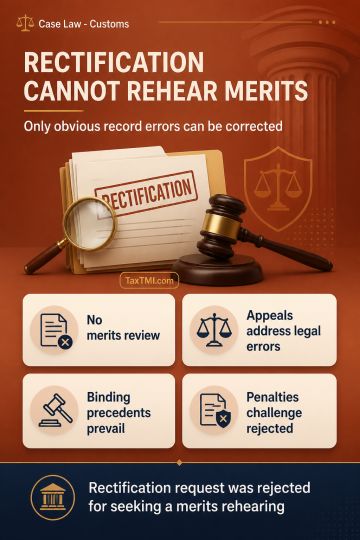
Rectification of mistake remains limited to self-evident record errors, preventing merits review through miscellaneous applications and preserving fin...
Tender creditworthiness conditions may extend to de facto Promoter Directors, with post-participation challenges generally barred absent arbitrariness...
Corporate representation in PMLA summons proceedings permitted through an authorised signatory, subject to directors' continuing cooperation and atten...
Helicopter charter classification requires effective control analysis, while territorial performance, reasoned credit orders and wilful suppression de...
Specified fund definition expands PAN exemption eligibility for registered alternative investment funds and qualifying International Financial Service...
Tax exemption for specified legal-services authority income applies retrospectively, subject to non-commercial activity, unchanged income sources, and...
ITAT followed its earlier orders in the assessee's own case and applied the same transfer pricing treatment for the year under appeal. For the ITES segment, it treated the benchmarking issue as covered by precedent and allowed the assessee's challenge to the arm's length price adjustment. For receivables from associated enterprises, it directed that delayed amounts beyond 90 days be benchmarked using 3 months' average Euribor plus 200 basis points, rather than sustaining the adjustment. For imported fixed assets, it held that a nil value could not be adopted and accepted the customs-determined value as the fair value, setting aside the transfer pricing adjustment.
ITAT followed its earlier orders in the assessee's own case and applied the same transfer pricing treatment for the year under appeal. For the ITES segment, it treated the benchmarking issue as covered by precedent and allowed the assessee's challenge to the arm's length price adjustment. For receivables from associated enterprises, it directed that delayed amounts beyond 90 days be benchmarked using 3 months' average Euribor plus 200 basis points, rather than sustaining the adjustment. For imported fixed assets, it held that a nil value could not be adopted and accepted the customs-determined value as the fair value, setting aside the transfer pricing adjustment.
Note: It is a system-generated summary and is for quick reference only.
 TaxTMI
 of 4805


















 Join Channel


 TaxTMI