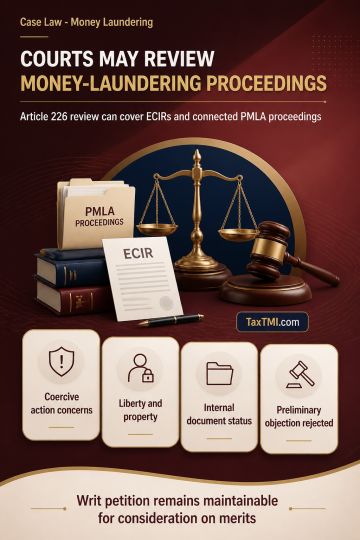
Constitutional judicial review permits challenges to ECIRs and connected money-laundering proceedings where coercive action affects fundamental intere...
Re-export of seized imported goods was permitted because the goods had remained under seizure for over a year, samples had already been drawn and tested, and their continued retention served no useful purpose. The Court did not examine the merits of the allegations of misclassification, undervaluation, or breach of minimum import price conditions. As the respondents did not seriously oppose re-export, permission was granted subject to safeguards: execution of a bond for the differential duty liability and furnishing of a bank guarantee equal to 5% of the re-determined value.
Re-export of seized imported goods was permitted because the goods had remained under seizure for over a year, samples had already been drawn and tested, and their continued retention served no useful purpose. The Court did not examine the merits of the allegations of misclassification, undervaluation, or breach of minimum import price conditions. As the respondents did not seriously oppose re-export, permission was granted subject to safeguards: execution of a bond for the differential duty liability and furnishing of a bank guarantee equal to 5% of the re-determined value.
Note: It is a system-generated summary and is for quick reference only.
 TaxTMI
 of 4805













 Join Channel


 TaxTMI
