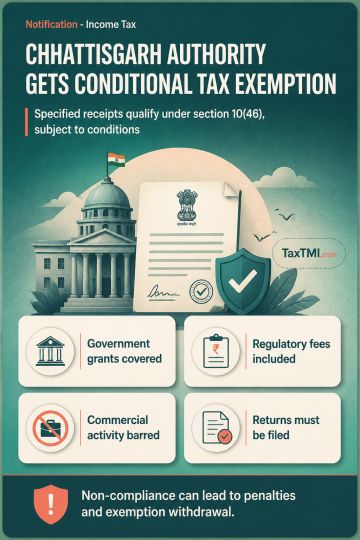
Specified regulatory authority income receives conditional tax exemption, subject to non-commercial activity, unchanged income character, and return f...
Tax exemption for regulatory authority income applies retrospectively, subject to non-commercial activity, unchanged income sources, and return-filing...
Input tax credit conditions remain constitutionally valid, with eligible recipient claims considered under GST circulars and retrospective filing dead...
Bogus donation receipts justified commission income assessment and defeated political-party tax exemption for inaccurate accounts and reporting failur...
Pure reimbursement without income element escapes tax withholding, while delayed withholding and unsupported provisions face deferred or renewed scrut...
Public benefit requirement defeats charitable registration where residents' association services are reciprocal, member-only facilities governed by mu...
Under the EPCG framework, the Tribunal treated the FTDR Act, Foreign Trade Policy, Handbook of Procedures and Customs notification as an integrated scheme and held that fulfilment of export obligation and validity of EODCs primarily lie with DGFT. Third-party exports were recognised as permissible under the scheme, which is value-based and does not require a rigid one-to-one correlation between imported capital goods and each export consignment. Because the EODCs had been restored by the competent DGFT appellate authority and the alleged fraud was not supported by primary documentary evidence, Customs could not disregard those subsisting determinations or deny EPCG benefits. On the same reasoning, penalties, confiscation and redemption fine were unsustainable.
Under the EPCG framework, the Tribunal treated the FTDR Act, Foreign Trade Policy, Handbook of Procedures and Customs notification as an integrated scheme and held that fulfilment of export obligation and validity of EODCs primarily lie with DGFT. Third-party exports were recognised as permissible under the scheme, which is value-based and does not require a rigid one-to-one correlation between imported capital goods and each export consignment. Because the EODCs had been restored by the competent DGFT appellate authority and the alleged fraud was not supported by primary documentary evidence, Customs could not disregard those subsisting determinations or deny EPCG benefits. On the same reasoning, penalties, confiscation and redemption fine were unsustainable.
Note: It is a system-generated summary and is for quick reference only.
 TaxTMI
 of 4805




















 Join Channel


 TaxTMI