Transfer pricing requires evidence for AMP transactions, functionally reliable comparables, and appropriate aggregation or Berry Ratio benchmarking me...
Revisionary jurisdiction cannot reopen share capital assessments where adequate inquiry supports a permissible view and no independent error is establ...
Reassessment jurisdiction fails where unverified portal information is aggregated without examining the taxpayer's explanation or relevance of entries...
Statutory sanction for delayed reassessment requires approval from the prescribed authority; approval by an inferior authority invalidates jurisdictio...
Transfer pricing margin adjustments require matching treatment of non-operating income and related costs, with comparability issues reconsidered on ev...
Preliminary-expense amortisation and MAT exempt-income adjustments prevailed, while trademark costs and managerial remuneration require fresh verifica...
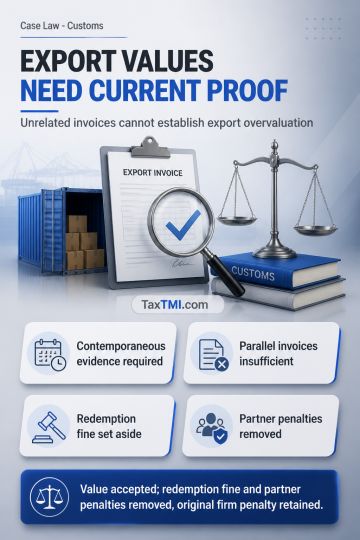
Export valuation requires contemporaneous evidence; unrelated invoices cannot prove overvaluation, and dual penalties on firm and partner are impermis...
Under the EPCG framework, the Tribunal treated the FTDR Act, Foreign Trade Policy, Handbook of Procedures and Customs notification as an integrated scheme and held that fulfilment of export obligation and validity of EODCs primarily lie with DGFT. Third-party exports were recognised as permissible under the scheme, which is value-based and does not require a rigid one-to-one correlation between imported capital goods and each export consignment. Because the EODCs had been restored by the competent DGFT appellate authority and the alleged fraud was not supported by primary documentary evidence, Customs could not disregard those subsisting determinations or deny EPCG benefits. On the same reasoning, penalties, confiscation and redemption fine were unsustainable.
Under the EPCG framework, the Tribunal treated the FTDR Act, Foreign Trade Policy, Handbook of Procedures and Customs notification as an integrated scheme and held that fulfilment of export obligation and validity of EODCs primarily lie with DGFT. Third-party exports were recognised as permissible under the scheme, which is value-based and does not require a rigid one-to-one correlation between imported capital goods and each export consignment. Because the EODCs had been restored by the competent DGFT appellate authority and the alleged fraud was not supported by primary documentary evidence, Customs could not disregard those subsisting determinations or deny EPCG benefits. On the same reasoning, penalties, confiscation and redemption fine were unsustainable.
Note: It is a system-generated summary and is for quick reference only.
 TaxTMI
  TaxTMI
 of 4807





















 Join Channel


