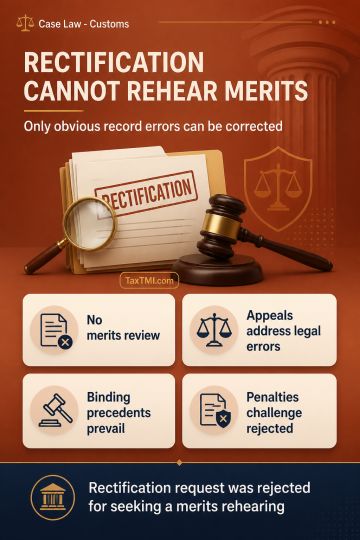
Rectification of mistake remains limited to self-evident record errors, preventing merits review through miscellaneous applications and preserving fin...
Tender creditworthiness conditions may extend to de facto Promoter Directors, with post-participation challenges generally barred absent arbitrariness...
Corporate representation in PMLA summons proceedings permitted through an authorised signatory, subject to directors' continuing cooperation and atten...
Helicopter charter classification requires effective control analysis, while territorial performance, reasoned credit orders and wilful suppression de...
Specified fund definition expands PAN exemption eligibility for registered alternative investment funds and qualifying International Financial Service...
Tax exemption for specified legal-services authority income applies retrospectively, subject to non-commercial activity, unchanged income sources, and...
The Supreme Court held that the 2001 SEBI Circular required disclosure of positions breaching prescribed limits and created no per se prohibition on excess positions; however, the appellant's failure to disclose agency-based trades with twelve entities attracted penalty under the Circular. The futures positions were accepted as valid hedges against intended cash-market sales, because anticipatory hedging was permissible and no 2007 rule required a perfect one-to-one correlation or formal hedging policy. Concentration of open interest, viewed on the correct combined-position basis, did not by itself prove manipulative cornering, and the alleged last-minute cash sale was not shown by cogent material to be price manipulation. Accordingly, PFUTP fraud and disgorgement were set aside, while the disclosure penalty was sustained.
The Supreme Court held that the 2001 SEBI Circular required disclosure of positions breaching prescribed limits and created no per se prohibition on excess positions; however, the appellant's failure to disclose agency-based trades with twelve entities attracted penalty under the Circular. The futures positions were accepted as valid hedges against intended cash-market sales, because anticipatory hedging was permissible and no 2007 rule required a perfect one-to-one correlation or formal hedging policy. Concentration of open interest, viewed on the correct combined-position basis, did not by itself prove manipulative cornering, and the alleged last-minute cash sale was not shown by cogent material to be price manipulation. Accordingly, PFUTP fraud and disgorgement were set aside, while the disclosure penalty was sustained.
Note: It is a system-generated summary and is for quick reference only.
 TaxTMI
 of 4805




















 Join Channel


 TaxTMI