Educational approval requires mandatory State registration, but incidental surplus and trustee-owned land do not prove private benefit or profit motiv...
Judicial review of settlement orders cannot reopen settled customs notices, while statutory interest remains subject to verification and quantificatio...
Customs Broker licence lending for consideration justified revocation where exporter authorisation and client verification obligations were also breac...
Fraudulent import documents suspend limitation protection, while redemption of confiscated goods requires duty and interest despite bona fide purchase...
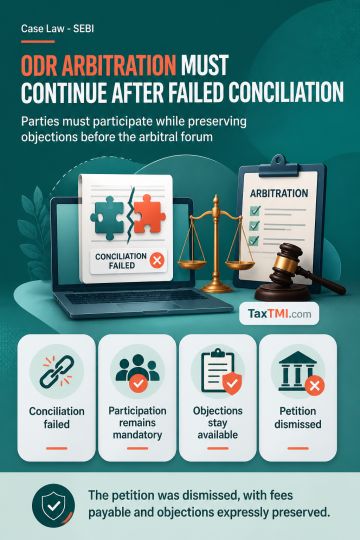
ODR arbitration participation remains mandatory after failed conciliation, while jurisdictional and maintainability objections stay available before t...
Transparency in technical bid evaluation requires disclosed standards and recorded reasons; opaque scoring invalidated tender awards and required fres...
The Supreme Court held that the 2001 SEBI Circular required disclosure of positions breaching prescribed limits and created no per se prohibition on excess positions; however, the appellant's failure to disclose agency-based trades with twelve entities attracted penalty under the Circular. The futures positions were accepted as valid hedges against intended cash-market sales, because anticipatory hedging was permissible and no 2007 rule required a perfect one-to-one correlation or formal hedging policy. Concentration of open interest, viewed on the correct combined-position basis, did not by itself prove manipulative cornering, and the alleged last-minute cash sale was not shown by cogent material to be price manipulation. Accordingly, PFUTP fraud and disgorgement were set aside, while the disclosure penalty was sustained.
The Supreme Court held that the 2001 SEBI Circular required disclosure of positions breaching prescribed limits and created no per se prohibition on excess positions; however, the appellant's failure to disclose agency-based trades with twelve entities attracted penalty under the Circular. The futures positions were accepted as valid hedges against intended cash-market sales, because anticipatory hedging was permissible and no 2007 rule required a perfect one-to-one correlation or formal hedging policy. Concentration of open interest, viewed on the correct combined-position basis, did not by itself prove manipulative cornering, and the alleged last-minute cash sale was not shown by cogent material to be price manipulation. Accordingly, PFUTP fraud and disgorgement were set aside, while the disclosure penalty was sustained.
Note: It is a system-generated summary and is for quick reference only.
 TaxTMI
  TaxTMI
 of 4809




















 Join Channel