Online bond platforms may offer overseas-regulated products and tax-specific bonds subject to disclosures, compliance safeguards and revised complianc...
Corporate guarantee valuation permits actual ascertainable commission while barring retroactive application and extended-period penalties for bona fid...
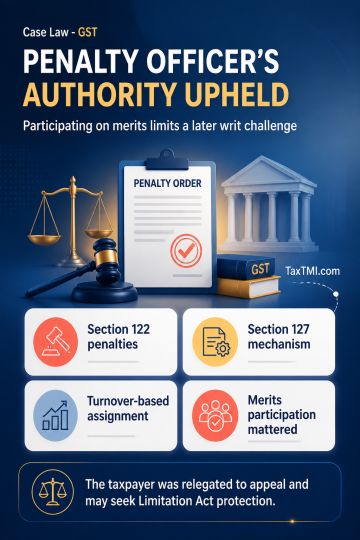
Proper-officer jurisdiction under UPGST penalty provisions upheld; participation on merits prevents bypassing the statutory appellate remedy through w...
Transitioned CENVAT credit may validly satisfy mandatory pre-deposit requirements for legacy service tax appeals through Electronic Credit Ledger debi...
Building-plan sanction charges require statutory authority; unauthorised fees and GST were quashed, while labour cess must follow prescribed collectio...
Pure-agent exclusion fails where hotel booking facilitators receive third-party services themselves, making entire customer consideration taxable as r...
The Supreme Court held that the 2001 SEBI Circular required disclosure of positions breaching prescribed limits and created no per se prohibition on excess positions; however, the appellant's failure to disclose agency-based trades with twelve entities attracted penalty under the Circular. The futures positions were accepted as valid hedges against intended cash-market sales, because anticipatory hedging was permissible and no 2007 rule required a perfect one-to-one correlation or formal hedging policy. Concentration of open interest, viewed on the correct combined-position basis, did not by itself prove manipulative cornering, and the alleged last-minute cash sale was not shown by cogent material to be price manipulation. Accordingly, PFUTP fraud and disgorgement were set aside, while the disclosure penalty was sustained.
The Supreme Court held that the 2001 SEBI Circular required disclosure of positions breaching prescribed limits and created no per se prohibition on excess positions; however, the appellant's failure to disclose agency-based trades with twelve entities attracted penalty under the Circular. The futures positions were accepted as valid hedges against intended cash-market sales, because anticipatory hedging was permissible and no 2007 rule required a perfect one-to-one correlation or formal hedging policy. Concentration of open interest, viewed on the correct combined-position basis, did not by itself prove manipulative cornering, and the alleged last-minute cash sale was not shown by cogent material to be price manipulation. Accordingly, PFUTP fraud and disgorgement were set aside, while the disclosure penalty was sustained.
Note: It is a system-generated summary and is for quick reference only.
 TaxTMI
  TaxTMI
 of 4807



















 Join Channel