Transfer pricing requires evidence for AMP transactions, functionally reliable comparables, and appropriate aggregation or Berry Ratio benchmarking me...
Revisionary jurisdiction cannot reopen share capital assessments where adequate inquiry supports a permissible view and no independent error is establ...
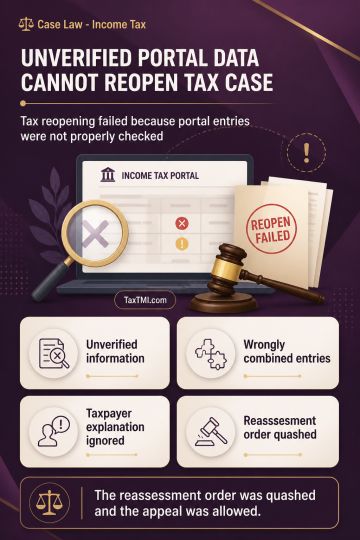
Reassessment jurisdiction fails where unverified portal information is aggregated without examining the taxpayer's explanation or relevance of entries...
Statutory sanction for delayed reassessment requires approval from the prescribed authority; approval by an inferior authority invalidates jurisdictio...
Transfer pricing margin adjustments require matching treatment of non-operating income and related costs, with comparability issues reconsidered on ev...
Preliminary-expense amortisation and MAT exempt-income adjustments prevailed, while trademark costs and managerial remuneration require fresh verifica...
Export valuation requires contemporaneous evidence; unrelated invoices cannot prove overvaluation, and dual penalties on firm and partner are impermis...
The Supreme Court held that inter-connected merger steps were...
Merger control notice and disclosure rules: Supreme Court limits penalties, rejects reopening of approved combination, and sets aside adverse findings.
Contents
Summary
Note
Bookmark
Share
✓ Copied successfully !
Print
Print Options
For full text, please login
Login to TaxTMI
Verification Pending
The Email Id has not been verified. Click on the link we have sent on
The Supreme Court held that inter-connected merger steps were adequately notified where the relevant agreements and their commercial linkages were placed on record and assessed in substance, so the transaction could not be treated as a complete non-notification. Section 43A could not be used as an omnibus penalty for alleged under-characterisation once a notice had been filed, reviewed and approved; any complaint of omission or false statement had to satisfy the specific ingredients of Sections 44 and 45. The Court further held that the post-one-year directions reopening the approved combination, keeping approval in abeyance and requiring a fresh Form II filing were beyond jurisdiction, lacked statutory authority, and in any event breached natural justice.
The Supreme Court held that inter-connected merger steps were adequately notified where the relevant agreements and their commercial linkages were placed on record and assessed in substance, so the transaction could not be treated as a complete non-notification. Section 43A could not be used as an omnibus penalty for alleged under-characterisation once a notice had been filed, reviewed and approved; any complaint of omission or false statement had to satisfy the specific ingredients of Sections 44 and 45. The Court further held that the post-one-year directions reopening the approved combination, keeping approval in abeyance and requiring a fresh Form II filing were beyond jurisdiction, lacked statutory authority, and in any event breached natural justice.
Note: It is a system-generated summary and is for quick reference only.
 TaxTMI
  TaxTMI
 of 4814





















 Join Channel