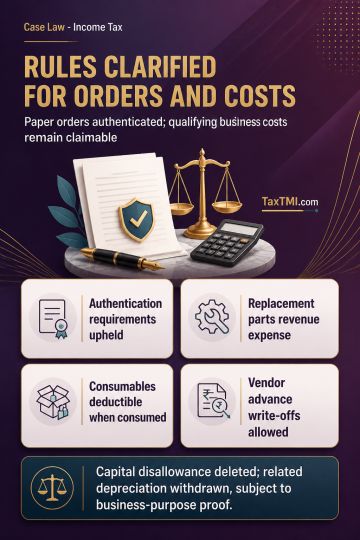
Authentication of paper assessment orders upheld, while qualifying repairs, consumables and vendor advance write-offs remain deductible business claim...
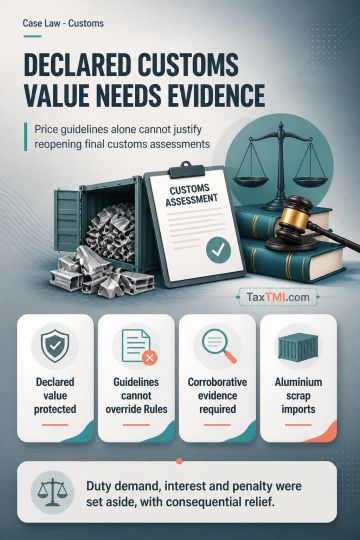
Transaction value cannot be rejected solely on non-statutory valuation guidelines without corroborative evidence supporting reassessment of final cust...
Cross-examination rights and corroborated evidence limit customs penalties for misdeclaration in genuine import transactions involving documented clea...
Page of 4809
Press 'Enter' after typing page number.
841 to 860 of 96176 Results
❮
❯
❯❯
0 / 200
Expand Note
Add to Folder
No Folders have been created
+
Are you sure you want to delete "My most important" ?
Proof of demand is the gravamen of offences under Sections 7 and 13 of the Prevention of Corruption Act, and recovery of tainted money alone is insufficient without reliable evidence of demand and voluntary acceptance. The Supreme Court upheld the acquittal because the prosecution failed to establish the foundational facts beyond reasonable doubt, material witnesses did not support its case in material particulars, and the statutory presumption under Section 20 could not be invoked. The conspiracy charge also failed because there was no cogent evidence of prior agreement or meeting of minds. The Court further accepted an adverse inference from the non-production of the alleged tape-recorded conversation and declined to interfere with the High Court's plausible view.
Proof of demand is the gravamen of offences under Sections 7 and 13 of the Prevention of Corruption Act, and recovery of tainted money alone is insufficient without reliable evidence of demand and voluntary acceptance. The Supreme Court upheld the acquittal because the prosecution failed to establish the foundational facts beyond reasonable doubt, material witnesses did not support its case in material particulars, and the statutory presumption under Section 20 could not be invoked. The conspiracy charge also failed because there was no cogent evidence of prior agreement or meeting of minds. The Court further accepted an adverse inference from the non-production of the alleged tape-recorded conversation and declined to interfere with the High Court's plausible view.
Note: It is a system-generated summary and is for quick reference only.
 TaxTMI
  TaxTMI
 of 4809




 Join Channel




