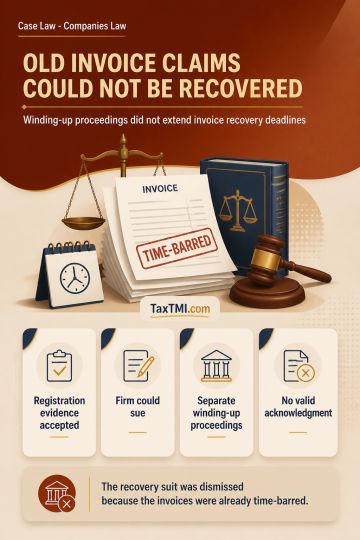
Invoice-based recovery claims remain time-barred despite separate winding-up proceedings, absent valid acknowledgment or part-payment of the disputed ...
Extended limitation fails without specific suppression allegations, while overseas employee secondment remains taxable as manpower supply within norma...
Time-share accommodation classification excludes Club or Association Service where purchasers receive contractual occupancy rights without genuine mem...
CENVAT credit for trading requires reversal, while taxable-service rental credit remains proportionately available and limitation issues await resolut...
Vicarious liability for dishonoured company cheques may extend to non-signatory directors where complaints contain foundational responsibility avermen...
Proof of demand is the gravamen of offences under Sections 7 and 13 of the Prevention of Corruption Act, and recovery of tainted money alone is insufficient without reliable evidence of demand and voluntary acceptance. The Supreme Court upheld the acquittal because the prosecution failed to establish the foundational facts beyond reasonable doubt, material witnesses did not support its case in material particulars, and the statutory presumption under Section 20 could not be invoked. The conspiracy charge also failed because there was no cogent evidence of prior agreement or meeting of minds. The Court further accepted an adverse inference from the non-production of the alleged tape-recorded conversation and declined to interfere with the High Court's plausible view.
Proof of demand is the gravamen of offences under Sections 7 and 13 of the Prevention of Corruption Act, and recovery of tainted money alone is insufficient without reliable evidence of demand and voluntary acceptance. The Supreme Court upheld the acquittal because the prosecution failed to establish the foundational facts beyond reasonable doubt, material witnesses did not support its case in material particulars, and the statutory presumption under Section 20 could not be invoked. The conspiracy charge also failed because there was no cogent evidence of prior agreement or meeting of minds. The Court further accepted an adverse inference from the non-production of the alleged tape-recorded conversation and declined to interfere with the High Court's plausible view.
Note: It is a system-generated summary and is for quick reference only.
 TaxTMI
  TaxTMI
 of 4811












 Join Channel