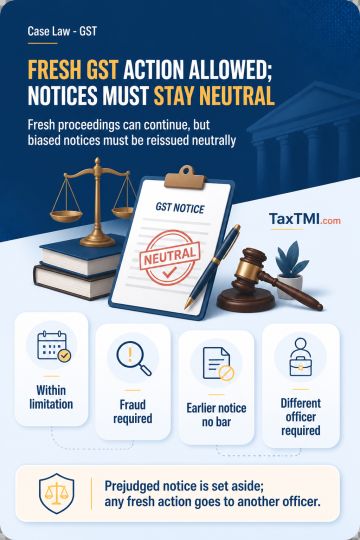
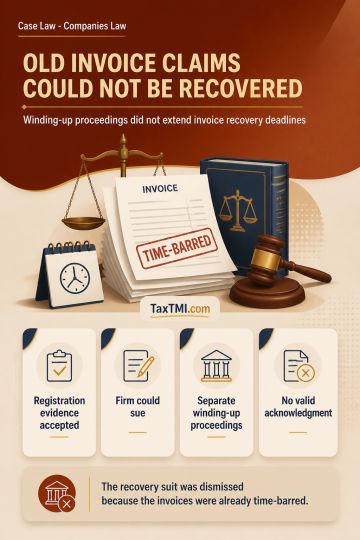
Invoice-based recovery claims remain time-barred despite separate winding-up proceedings, absent valid acknowledgment or part-payment of the disputed ...
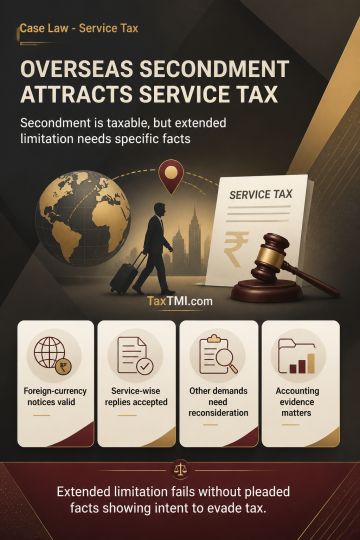
Extended limitation fails without specific suppression allegations, while overseas employee secondment remains taxable as manpower supply within norma...
Time-share accommodation classification excludes Club or Association Service where purchasers receive contractual occupancy rights without genuine mem...
CENVAT credit for trading requires reversal, while taxable-service rental credit remains proportionately available and limitation issues await resolut...
Vicarious liability for dishonoured company cheques may extend to non-signatory directors where complaints contain foundational responsibility avermen...
Concessional electricity charges under Clause 16(a) of the 2019 Industrial Policy were held to apply only to new industrial enterprises, while existing enterprises undertaking substantial expansion fell under Clause 16(b) and could claim only the rebate linked to incremental consumption. The 29.04.2022 amendment substituting "eligible" with "new" in Clause 16(a) and aligning Clause 16(b) with substantial expansion was treated as clarificatory and retrospective, except for the newly introduced three-year duration under Clause 16(b), which operated prospectively. The respondent therefore had no entitlement to Clause 16(a) concession, and promissory estoppel could not create a benefit beyond the Policy's true scope.
Concessional electricity charges under Clause 16(a) of the 2019 Industrial Policy were held to apply only to new industrial enterprises, while existing enterprises undertaking substantial expansion fell under Clause 16(b) and could claim only the rebate linked to incremental consumption. The 29.04.2022 amendment substituting "eligible" with "new" in Clause 16(a) and aligning Clause 16(b) with substantial expansion was treated as clarificatory and retrospective, except for the newly introduced three-year duration under Clause 16(b), which operated prospectively. The respondent therefore had no entitlement to Clause 16(a) concession, and promissory estoppel could not create a benefit beyond the Policy's true scope.
Note: It is a system-generated summary and is for quick reference only.
 TaxTMI
  TaxTMI
 of 4811









 Join Channel