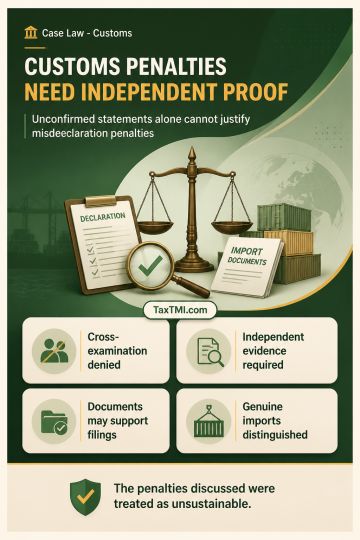
Cross-examination rights and corroborated evidence limit customs penalties for misdeclaration in genuine import transactions involving documented clea...
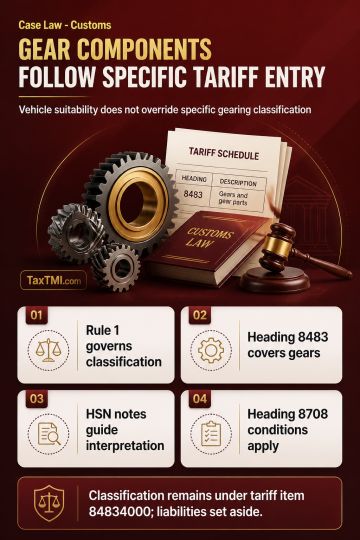
Tariff classification of vehicle gear components follows the specific gearing entry, displacing motor-vehicle parts classification and related liabili...
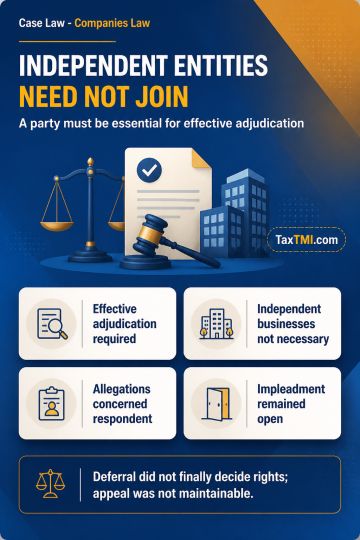
Necessary-party requirements limit impleadment of independent entities, while deferred consideration does not create an appealable adverse determinati...
Food supplement classification requires common parlance and authoritative tests, preventing treatment as proprietary Ayurvedic medicines without suppo...
Specified regulatory authority income receives conditional tax exemption, subject to non-commercial activity, unchanged income character, and return f...
Tax exemption for regulatory authority income applies retrospectively, subject to non-commercial activity, unchanged income sources, and return-filing...
Under GST, a transit State may intercept, inspect and physically verify goods in movement, but that regulatory power does not extend to detention or penalty where the transaction neither originates in nor terminates in that State and no tax is payable there. Cross-empowerment under the State and Central Acts, read with the IGST framework, operates only between authorities dealing with the same State and taxable transaction; it does not authorise one State's GST officers to penalise an inter-State movement passing through its territory. A valid e-way bill and tax invoice, without any allegation of bogus documents or local supply, require only reporting of any documentation defect to the competent authorities in the relevant originating or destination State.
Under GST, a transit State may intercept, inspect and physically verify goods in movement, but that regulatory power does not extend to detention or penalty where the transaction neither originates in nor terminates in that State and no tax is payable there. Cross-empowerment under the State and Central Acts, read with the IGST framework, operates only between authorities dealing with the same State and taxable transaction; it does not authorise one State's GST officers to penalise an inter-State movement passing through its territory. A valid e-way bill and tax invoice, without any allegation of bogus documents or local supply, require only reporting of any documentation defect to the competent authorities in the relevant originating or destination State.
Note: It is a system-generated summary and is for quick reference only.
 TaxTMI
  TaxTMI
 of 4809













 Join Channel




