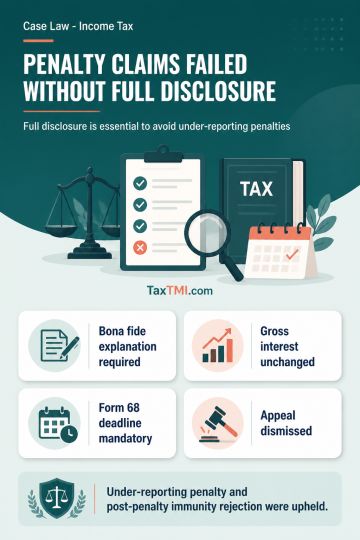
Bona fide disclosure requirements govern under-reporting penalties, and post-penalty immunity applications cannot secure available statutory protectio...
Certificate-of-origin verification procedure governs preferential customs benefits; denial without retroactive verification was set aside with consequ...
Disciplinary Committee jurisdiction and mandatory investigation requirements invalidated cancellation of an insolvency professional's registration and...
Penalty under Section 271DA was quashed because it rested on seized digital material and an alleged hawala token that had already been found inadmissible in the connected group case; once that electronic material could not validly support factual findings, it could not sustain the penalty. The Tribunal also held that the underlying transaction was a loan transaction and, if at all, fell within Section 269SS rather than Section 269ST. Since Section 269ST excludes transactions covered by Section 269SS, the penalty premised on Section 269ST was not legally tenable.
Penalty under Section 271DA was quashed because it rested on seized digital material and an alleged hawala token that had already been found inadmissible in the connected group case; once that electronic material could not validly support factual findings, it could not sustain the penalty. The Tribunal also held that the underlying transaction was a loan transaction and, if at all, fell within Section 269SS rather than Section 269ST. Since Section 269ST excludes transactions covered by Section 269SS, the penalty premised on Section 269ST was not legally tenable.
Note: It is a system-generated summary and is for quick reference only.
 TaxTMI
 of 4805














 Join Channel


 TaxTMI
