Prolonged sterilisation of development rights supports capital-gains treatment, while business-income disallowances cannot govern capital-gains comput...
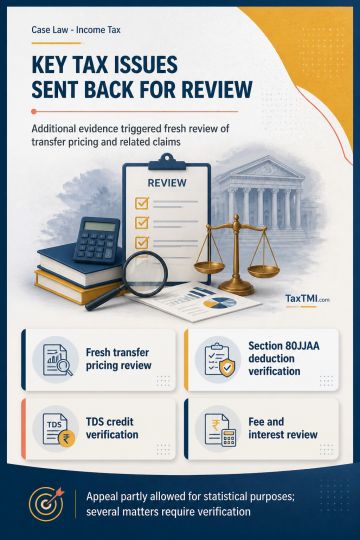
Additional evidence in transfer pricing dispute leads to fresh examination, while tax deductions, TDS credit, fee and refund interest require verifica...
Category II AIF pass-through taxation preserves non-business income character; investment receipts cannot be reclassified without applying recognised ...
Mutual fund maturity rules require proper rollover, redemption, disclosure, and due diligence; investor gains cannot excuse regulatory breaches or pen...
Threshold exemption excludes exempt services, while stamp-paper purchases avoid reverse charge; consequential service tax penalties were also set asid...
Liability to pay cost recovery charges for customs officers deployed at a Container Freight Station was upheld because the regulatory framework, consistent administrative practice and the petitioner's own prior remittances showed that operators were liable unless expressly exempted. The Court applied contemporanea expositio and substantial compliance, finding that actual customs deployment and supervision satisfied the statutory purpose, and that later internal cadre regularisation did not extinguish the obligation. The challenge was also barred by res judicata and estoppel by conduct, since the liability issue had already been litigated and the petitioner had accepted the levy over time. The remaining quantification dispute was treated as factual and unsuitable for writ jurisdiction, and the cargo movement restriction was sustained as a lawful response to persistent non-payment.
Liability to pay cost recovery charges for customs officers deployed at a Container Freight Station was upheld because the regulatory framework, consistent administrative practice and the petitioner's own prior remittances showed that operators were liable unless expressly exempted. The Court applied contemporanea expositio and substantial compliance, finding that actual customs deployment and supervision satisfied the statutory purpose, and that later internal cadre regularisation did not extinguish the obligation. The challenge was also barred by res judicata and estoppel by conduct, since the liability issue had already been litigated and the petitioner had accepted the levy over time. The remaining quantification dispute was treated as factual and unsuitable for writ jurisdiction, and the cargo movement restriction was sustained as a lawful response to persistent non-payment.
Note: It is a system-generated summary and is for quick reference only.
 TaxTMI
 of 4805




















 Join Channel


 TaxTMI
