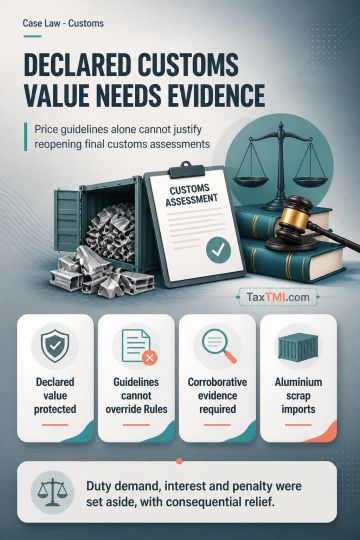
Transaction value cannot be rejected solely on non-statutory valuation guidelines without corroborative evidence supporting reassessment of final cust...
Cross-examination rights and corroborated evidence limit customs penalties for misdeclaration in genuine import transactions involving documented clea...
Tariff classification of vehicle gear components follows the specific gearing entry, displacing motor-vehicle parts classification and related liabili...
Necessary-party requirements limit impleadment of independent entities, while deferred consideration does not create an appealable adverse determinati...
Food supplement classification requires common parlance and authoritative tests, preventing treatment as proprietary Ayurvedic medicines without suppo...
Liability to pay cost recovery charges for customs officers deployed at a Container Freight Station was upheld because the regulatory framework, consistent administrative practice and the petitioner's own prior remittances showed that operators were liable unless expressly exempted. The Court applied contemporanea expositio and substantial compliance, finding that actual customs deployment and supervision satisfied the statutory purpose, and that later internal cadre regularisation did not extinguish the obligation. The challenge was also barred by res judicata and estoppel by conduct, since the liability issue had already been litigated and the petitioner had accepted the levy over time. The remaining quantification dispute was treated as factual and unsuitable for writ jurisdiction, and the cargo movement restriction was sustained as a lawful response to persistent non-payment.
Liability to pay cost recovery charges for customs officers deployed at a Container Freight Station was upheld because the regulatory framework, consistent administrative practice and the petitioner's own prior remittances showed that operators were liable unless expressly exempted. The Court applied contemporanea expositio and substantial compliance, finding that actual customs deployment and supervision satisfied the statutory purpose, and that later internal cadre regularisation did not extinguish the obligation. The challenge was also barred by res judicata and estoppel by conduct, since the liability issue had already been litigated and the petitioner had accepted the levy over time. The remaining quantification dispute was treated as factual and unsuitable for writ jurisdiction, and the cargo movement restriction was sustained as a lawful response to persistent non-payment.
Note: It is a system-generated summary and is for quick reference only.
 TaxTMI
 of 4805


















 Join Channel


 TaxTMI
