Higher depreciation for qualifying commercial vehicles, exempt-income disallowance, research deduction verification, and club-expense treatment clarif...
Charitable registration renewal cannot become an assessment of receipts, profitability or annual exemption compliance, requiring renewal and donation ...
AMP expenditure for own business is not an international transaction without an associated-enterprise arrangement, eliminating transfer pricing adjust...
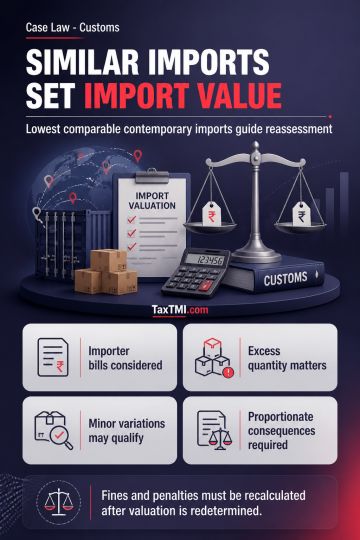
Customs valuation must use comparable contemporary imports, while confiscation fines and penalties require proportionate recalculation on reassessed v...
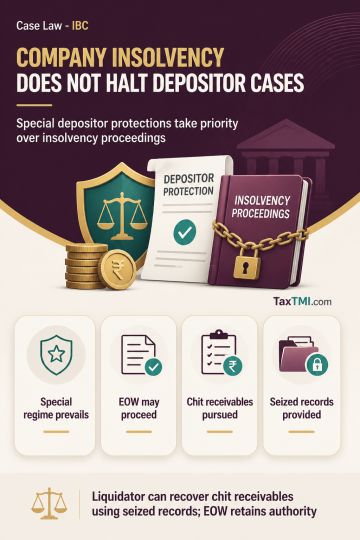
Depositor-protection proceedings prevail over corporate insolvency, while liquidators may recover chit receivables using copies of seized company reco...
Liability to pay cost recovery charges for customs officers deployed at a Container Freight Station was upheld because the regulatory framework, consistent administrative practice and the petitioner's own prior remittances showed that operators were liable unless expressly exempted. The Court applied contemporanea expositio and substantial compliance, finding that actual customs deployment and supervision satisfied the statutory purpose, and that later internal cadre regularisation did not extinguish the obligation. The challenge was also barred by res judicata and estoppel by conduct, since the liability issue had already been litigated and the petitioner had accepted the levy over time. The remaining quantification dispute was treated as factual and unsuitable for writ jurisdiction, and the cargo movement restriction was sustained as a lawful response to persistent non-payment.
Liability to pay cost recovery charges for customs officers deployed at a Container Freight Station was upheld because the regulatory framework, consistent administrative practice and the petitioner's own prior remittances showed that operators were liable unless expressly exempted. The Court applied contemporanea expositio and substantial compliance, finding that actual customs deployment and supervision satisfied the statutory purpose, and that later internal cadre regularisation did not extinguish the obligation. The challenge was also barred by res judicata and estoppel by conduct, since the liability issue had already been litigated and the petitioner had accepted the levy over time. The remaining quantification dispute was treated as factual and unsuitable for writ jurisdiction, and the cargo movement restriction was sustained as a lawful response to persistent non-payment.
Note: It is a system-generated summary and is for quick reference only.
 TaxTMI
  TaxTMI
 of 4811
















 Join Channel


