Revisionary jurisdiction cannot reopen share capital assessments where adequate inquiry supports a permissible view and no independent error is establ...
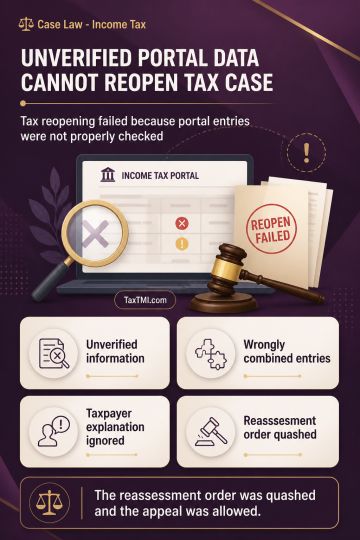
Reassessment jurisdiction fails where unverified portal information is aggregated without examining the taxpayer's explanation or relevance of entries...
Statutory sanction for delayed reassessment requires approval from the prescribed authority; approval by an inferior authority invalidates jurisdictio...
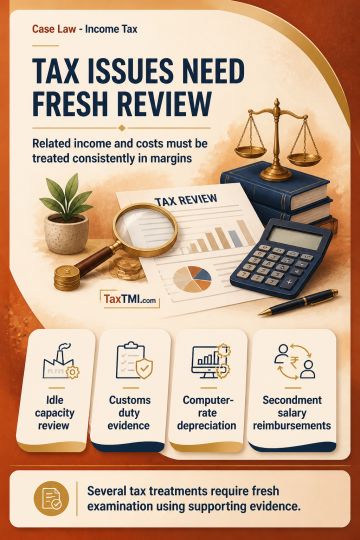
Transfer pricing margin adjustments require matching treatment of non-operating income and related costs, with comparability issues reconsidered on ev...
Preliminary-expense amortisation and MAT exempt-income adjustments prevailed, while trademark costs and managerial remuneration require fresh verifica...
Export valuation requires contemporaneous evidence; unrelated invoices cannot prove overvaluation, and dual penalties on firm and partner are impermis...
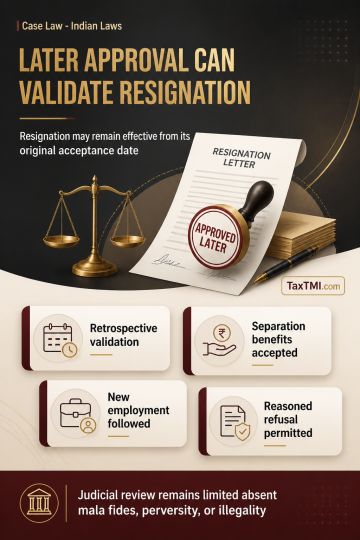
Ratification of resignation acceptance validates separation retrospectively, while withdrawal may be refused through reasoned administrative discretio...
Page of 4809
Press 'Enter' after typing page number.
321 to 340 of 96174 Results
❮
❯
❯❯
0 / 200
Expand Note
Add to Folder
No Folders have been created
+
Are you sure you want to delete "My most important" ?
Penalty under section 271AAB remained leviable on undisclosed cash found during search because the disclosure was made only after seizure and admission under section 132(4), so the assessee could not escape penalty merely because the returned income later matched the finally assessed income after quantum relief. The Tribunal held that clause (a) was inapplicable because the assessee did not specify or substantiate the manner of deriving the income, clause (b) was inapplicable because the income had in fact been admitted, and the case therefore fell under clause (c). As no extraordinary circumstances justified the maximum rate, the penalty under clause (c) was restricted to 30% of the undisclosed income.
Penalty under section 271AAB remained leviable on undisclosed cash found during search because the disclosure was made only after seizure and admission under section 132(4), so the assessee could not escape penalty merely because the returned income later matched the finally assessed income after quantum relief. The Tribunal held that clause (a) was inapplicable because the assessee did not specify or substantiate the manner of deriving the income, clause (b) was inapplicable because the income had in fact been admitted, and the case therefore fell under clause (c). As no extraordinary circumstances justified the maximum rate, the penalty under clause (c) was restricted to 30% of the undisclosed income.
Note: It is a system-generated summary and is for quick reference only.
 TaxTMI
  TaxTMI
 of 4809
















 Join Channel


